On Bark

Tree bark is one of those things difficult to describe without metaphor. It’s also one of those things people can recognize without being able to describe (giving rise to numerous not particularly helpful youtube videos, and demonstrating, by the way, that we can think, or at least categorize, outside of language). Whereas leaves can be described relatively precisely using a technical nomenclature (parallel vs. palmate vs pinnate venation for example), even scientific studies are forced to use terms like “platy” and “ropy” when describing bark, just as wine connoisseurs use words like “funky,” or “chewy.”

This lack of clear vocabulary, while frustrating, has the advantage of encouraging us to be poets or at least readers of poetry. We learn that northern red oaks have “ski trails,”
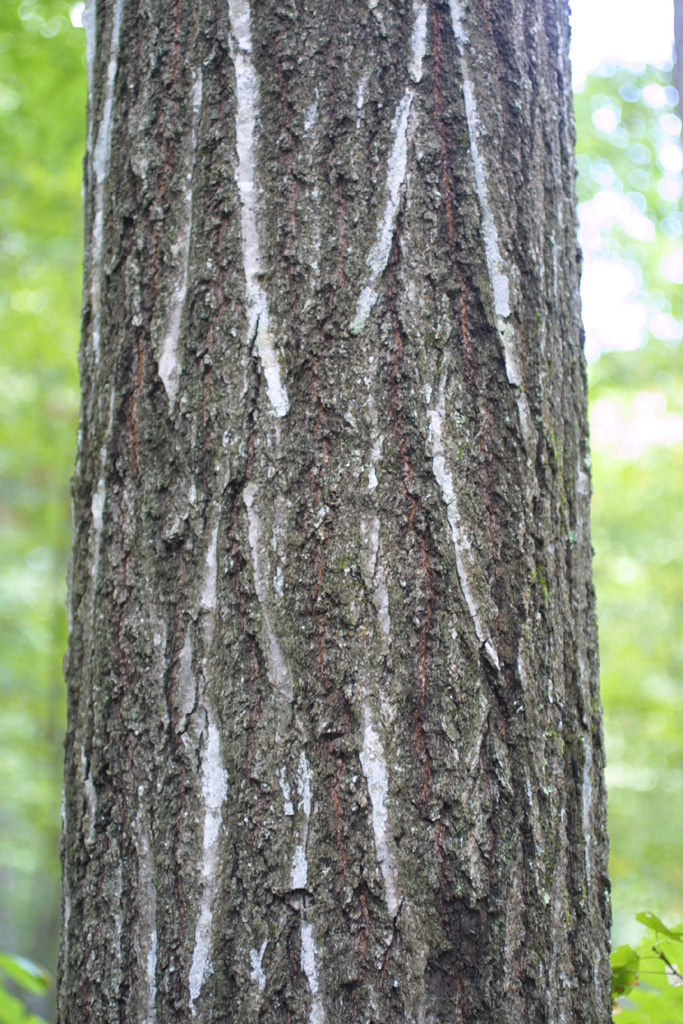
http://bioimages.vanderbilt.edu/baskauf/15732.htm. Northern Red Oak “ski trails”

and indeed they do. Shagbark hickory is like “beef jerky,” flowering dogwoods are like “alligator skin.” And there is something “ropy” about black locust bark, isn’t there?
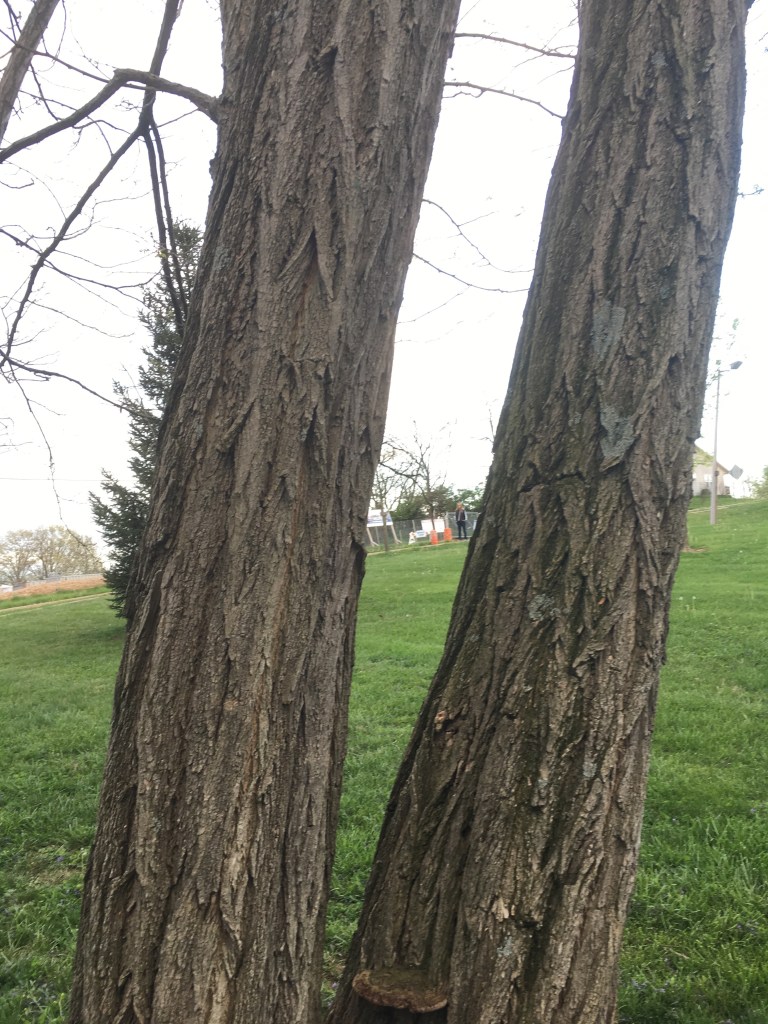
On the other hand, for the purposes of identification, it does help to break bark down into a series of contrast and categories, as we do with leaves. In lieu of a more precise terminology, the following are the descriptive contrasts I’ve found to be helpful identifying trees by bark.

Obviously, to start with, there is smooth vs. rough. I’m just going to focus on what could be called the more “barky bark”: rough bark. The next question is, are there strong vertical lines or is the bark scaly (like a black cherry or flowering dogwood)?
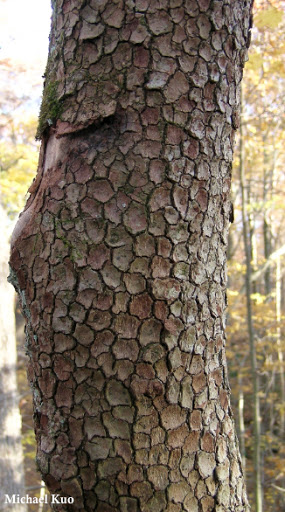
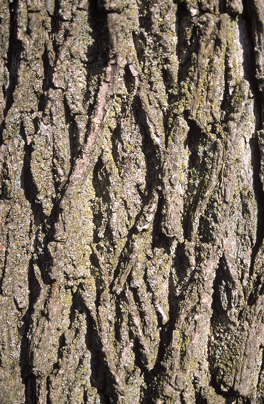
Assuming it has strong vertical lines, are they more like cracks (shallow fissures, flat ridges), strips (you could dig your finger under them and peel them off), or ridges?
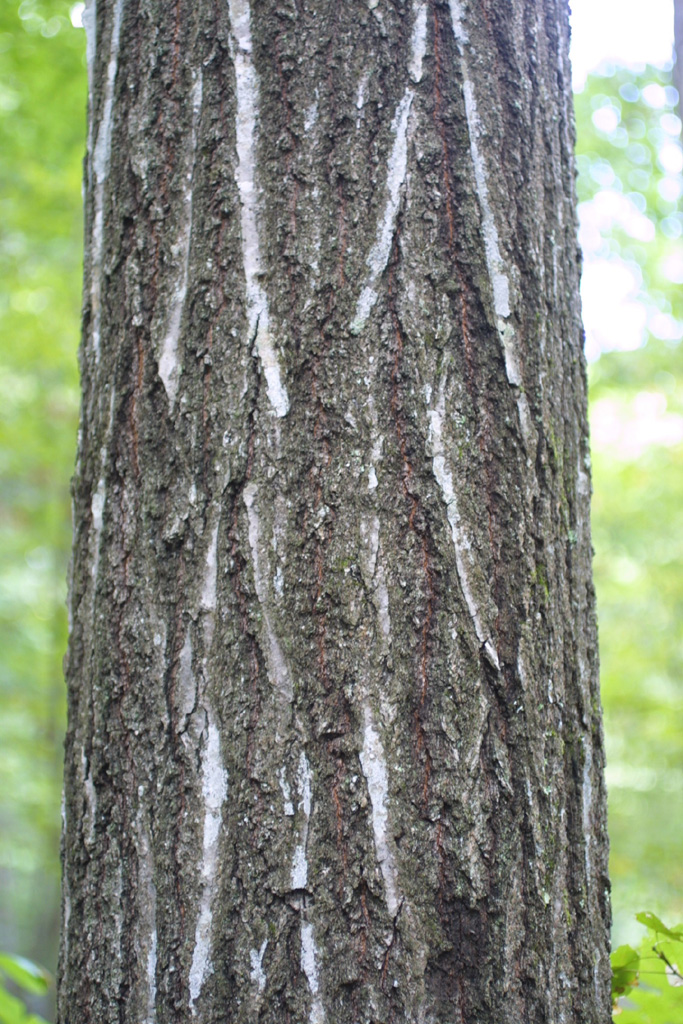
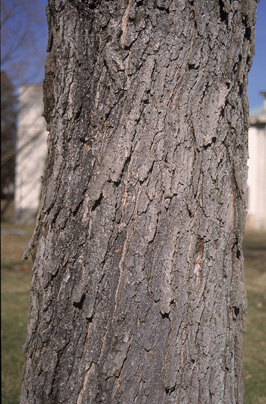
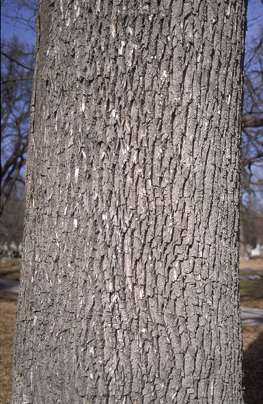
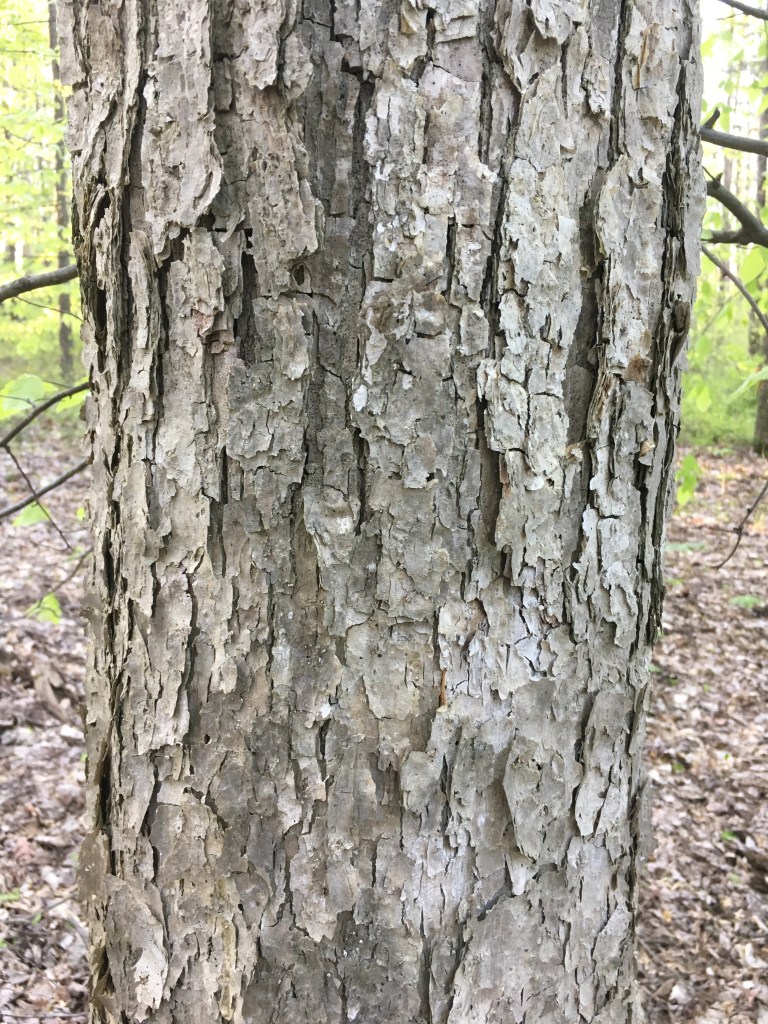
At this point, we usually need to bring in a few hints from the overall structure of the tree. Ash trees can be identified fairly easily because of their opposite branching. An extremely straight, regular trunk, with no low branches and bark that is “corrugated” (the tips of the ridges are flat, and the fissures are a uniform depth) separates out the tulip tree. White oaks tend to have paler bark, bark broken horizontally, or when younger, flaky bark.
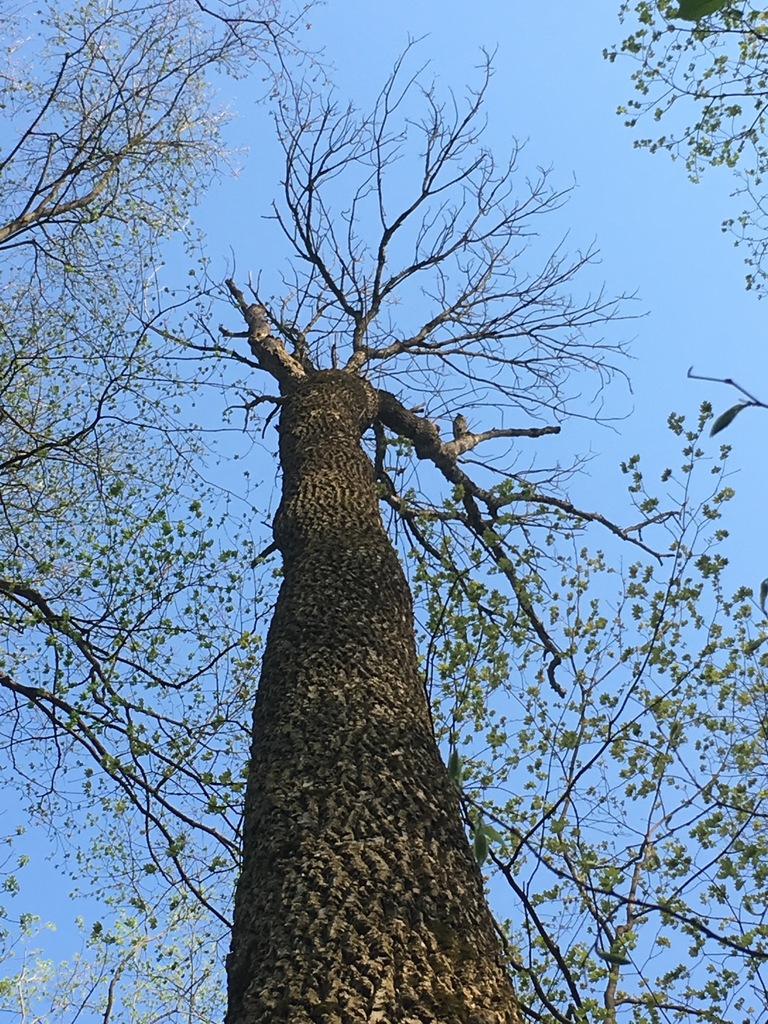
Ash tree, notice opposite branching
Tulips are usually impressively regular and straight with thin vertical lines.
Flaky young white oak (not sure of exact species)

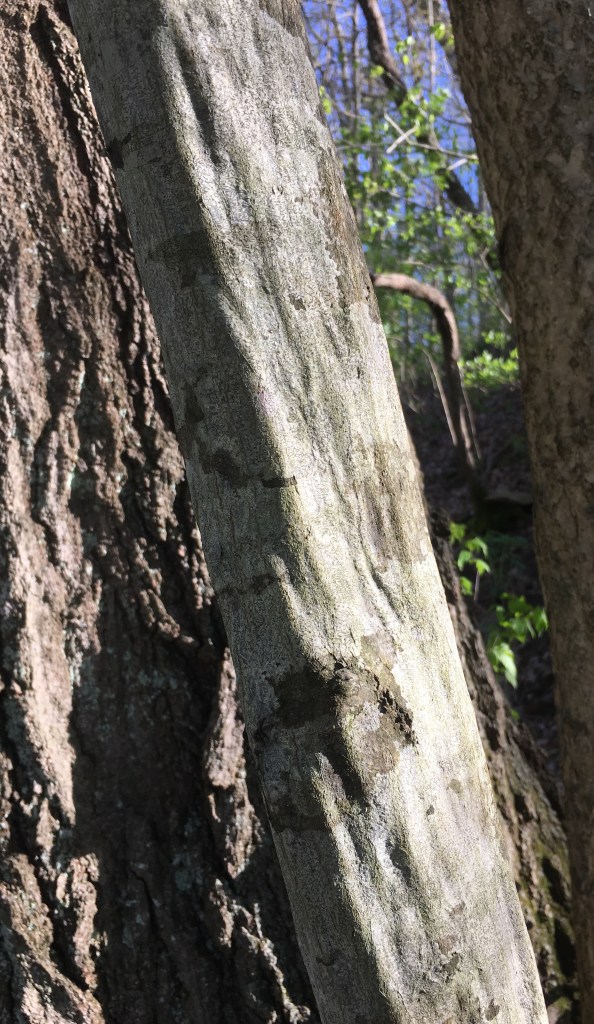
While I know this leaves many trees unidentified, I hope it is at least moderately helpful. There’s a lot more to it, but for now I’ll just mention a few of the remaining more distinctive barks. Above I mentioned the “ropy” texture of black locust, but even easier to spot is honey locust, because of its sharp spikes. And ironwood, or the American Hornbeam, is another smaller tree which is easy to identify because of its cordlike, almost muscular (here we go again with the metaphors) feel.
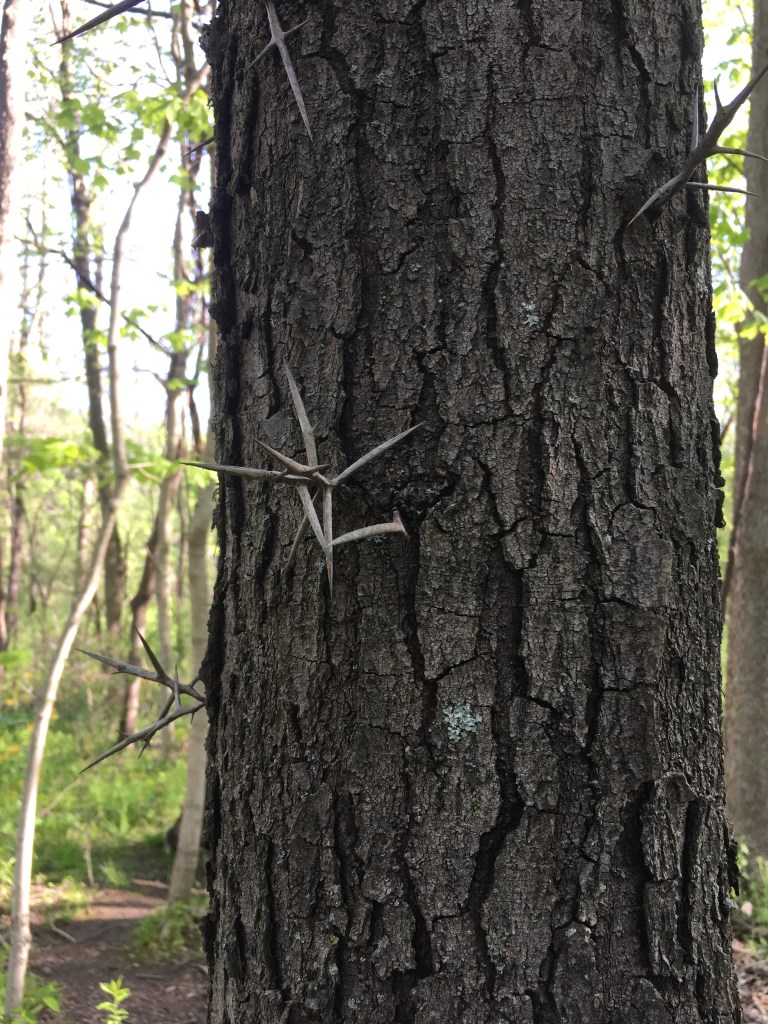
Nothing sweet about a honey locust’s bark
“veiny” Ironwood, how would you describe it? Rippled?

Lastly, I’m far from an expert in tree identification, which is part of the reason I set myself this project. The variation a single species can show over the course of its lifetime is fairly bewildering. Just when you think something is “distinctive,” you find out that another species does that too, or that not all trees of that species display that specific feature. Bark is highly variable based on things like rate of growth, disease, and soil conditions. This is why some people recommend learning twig structure, which does have a fairly precise technical vocabulary. I haven’t jumped into that just yet, but in any case, there’s something satisfying about being able to spot a stand of tulips forty yards away, up on the next ridge.
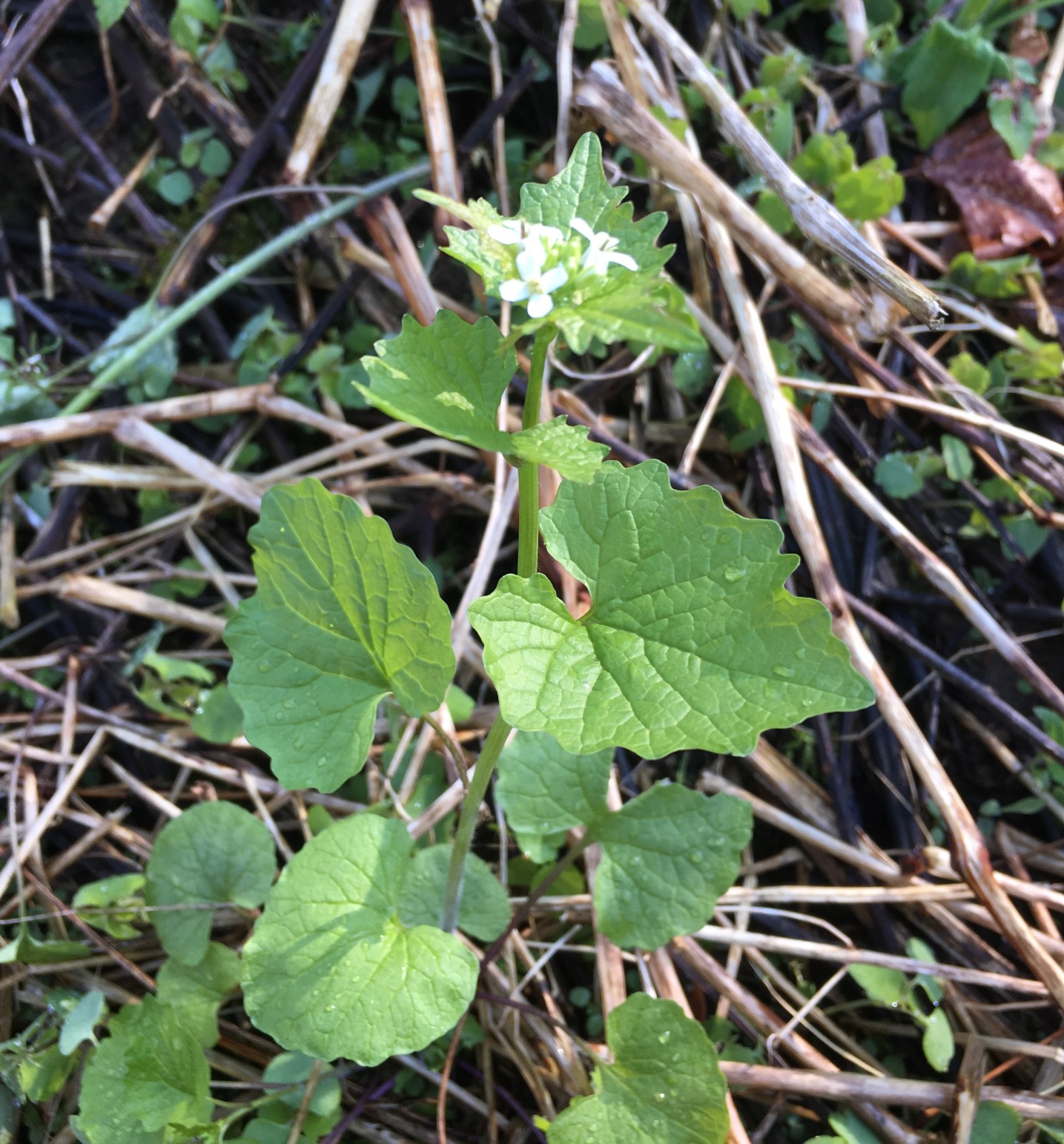
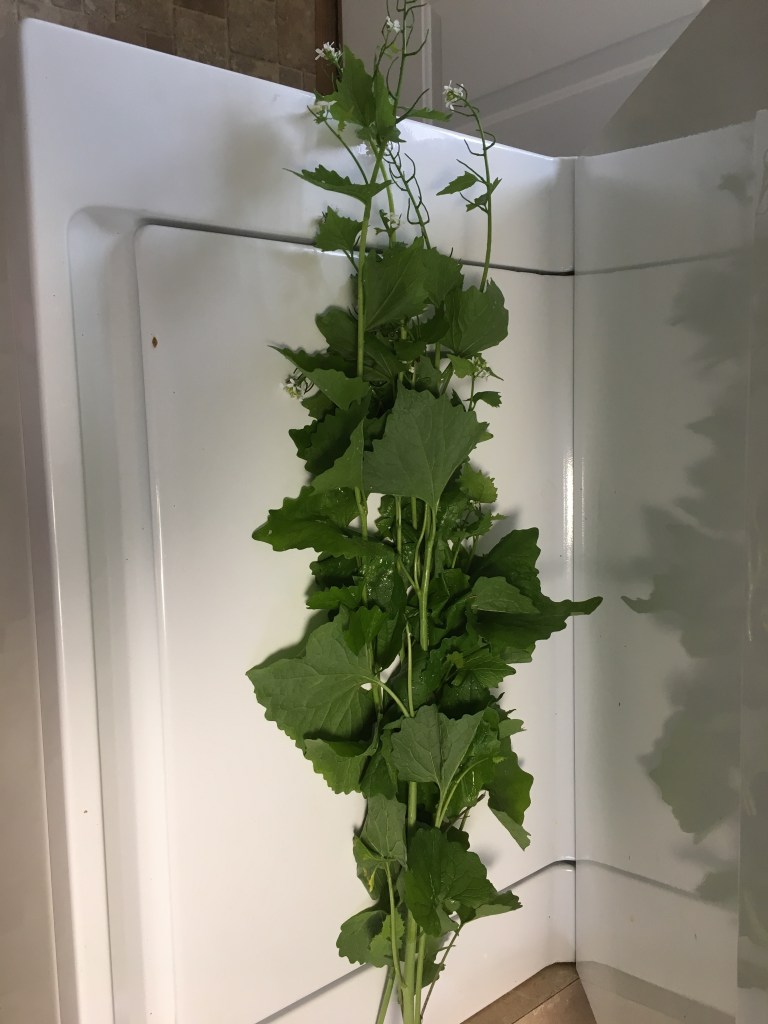
Garlic Mustard: it’s everywhere, why not eat it?

Eating Garlic Mustard is often urged as a way of fighting an invasive plant, but there’s another reason it’s worth a try: history. Ever come across those startling, seemingly inexplicable details when reading something older than the 20th century, such as that people used to sleep in two four hour shifts, or put eggs in their beer (I guess people still do this), or never bathe? For a minute we’re puzzled, then maybe we look it up, then we forget all about it and go on imagining the day-to-day life of times past essentially in the terms of our own day.

Recently, for example, I’ve been reading a biography of Peter the Great, full of such quizzical facts, startling when first come across but then quickly forgotten because they don’t fit in with my lived experience.

Well, think of Garlic Mustard as a little bit of a space-time traveling machine with a specific destination. Actually, people have been eating Garlic Mustard for over 6,000 years, but the invasive Garlic Mustard we have over here in the States is most closely related to the Garlic Mustard that grew in the British Isles before the 1800s. Garlic Mustard, also known as “Sauce-alone” or “Jack-by-the-hedge,” was a staple of English and Irish diets presumably from time immemorial until sometime in the 20th century. It was used in stews or made into a sauce for meat or eaten as “sallad.” So next time you need to channel Shakespeare or Samuel Johnson, or whoever you happen to be reading in your survey of British Literature class, try Garlic Mustard.

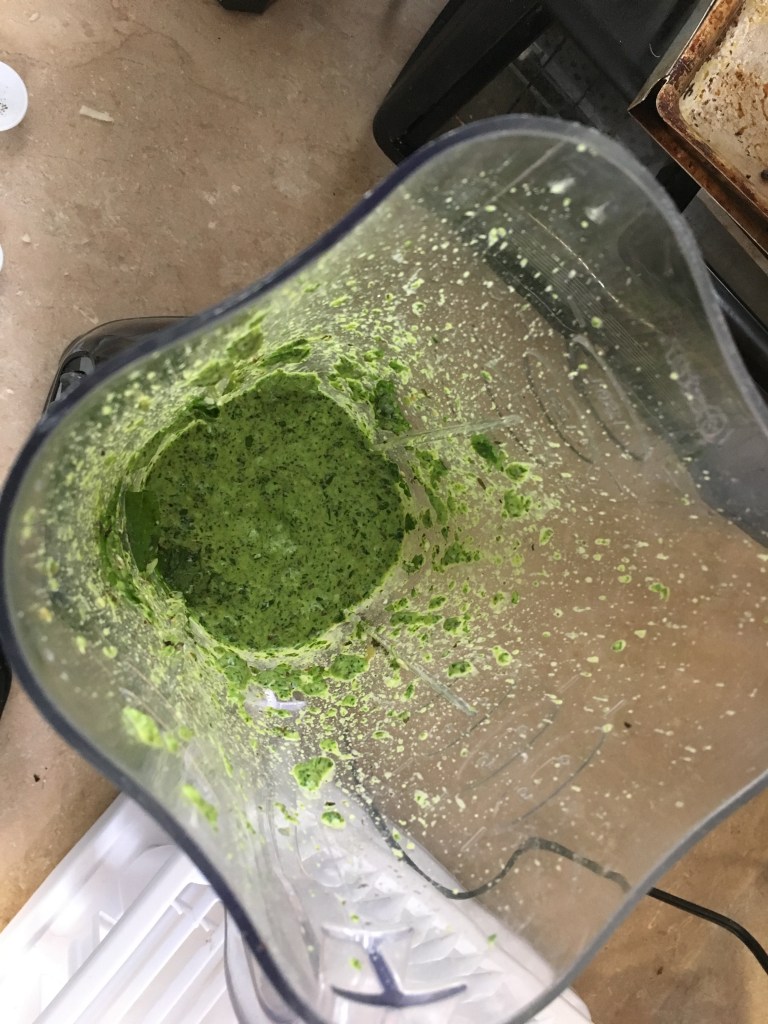
I chose to give the most common internet Garlic Mustard recipe a try: Garlic Mustard pesto. I didn’t have pine nuts, so I used some roasted pumpkin seeds from last fall, and I didn’t have parmesan so I used mozzarella. But all you really need is Garlic Mustard, olive oil, salt (and maybe some basil and oregano).

Now, I doubt that this is exactly how Shakespeare had his sauce-alone (not having a blender) but I would say that a few leaves ground up in a pestle with oil and salt would make a pretty good sauce for some lamb. I did try a few of the leaves plain and I’d say they’d make a pretty decent salad, a little bit on the spicy and bitter side, but I like that anyways.

For more on the subject see: https://www.history.com/news/shakespeares-suppers , https://en.wikisource.org/wiki/Domestic_Encyclopædia_(1802)/Mustard,_the_Hedge , https://en.wikipedia.org/wiki/Alliaria_petiolata

Nature the Bizarre

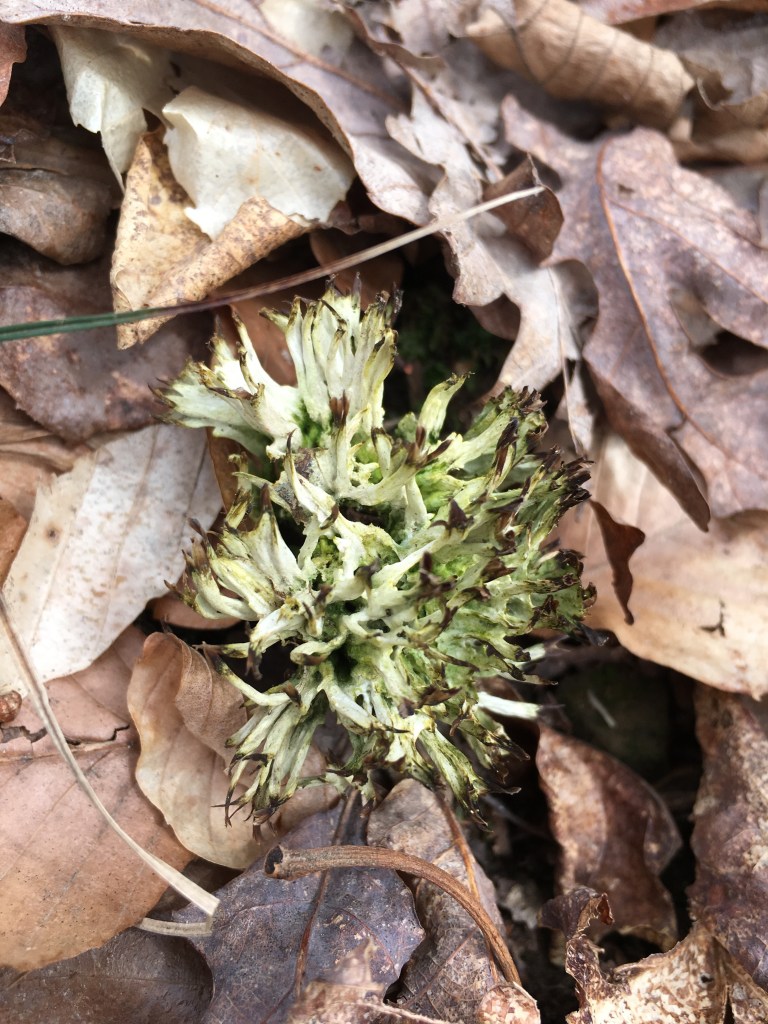
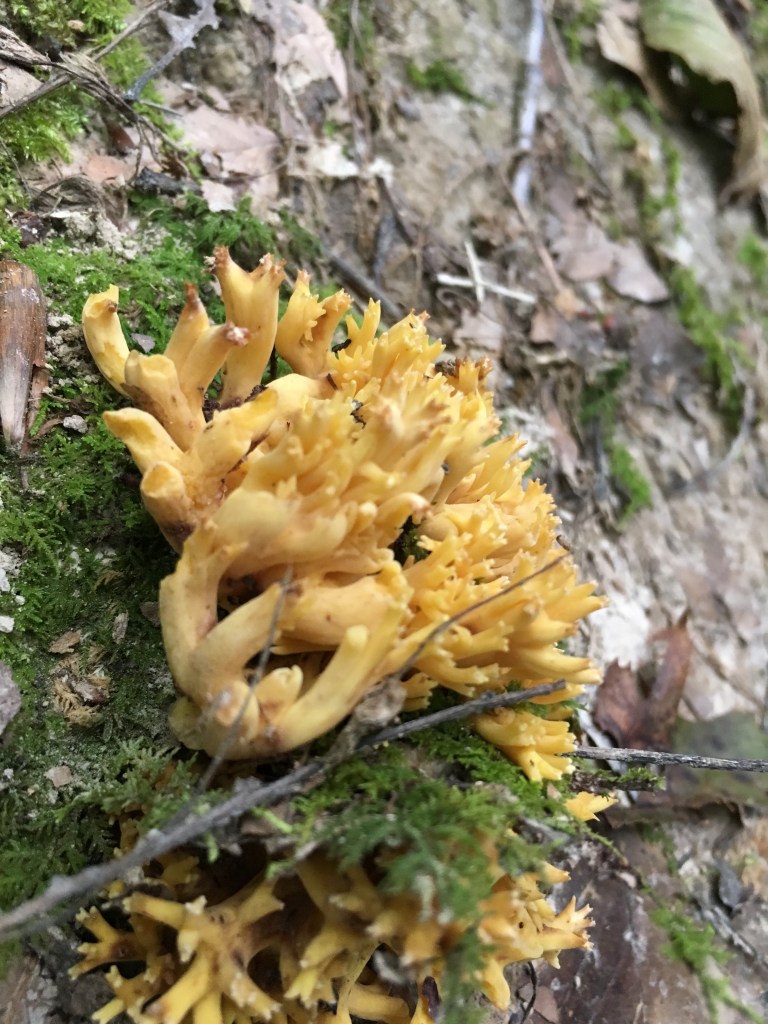
Today I’m going to show you some of the stranger things I’ve found hiking. Starting below, with some kind of coral fungus I haven’t managed to quite identify.

Unidenified Coral Fungus

I’ve seen this several times now, usually while poking around for signs of morels. The fungus above has become lichenized, which results in the green tint. All lichen, by the way, are part-fungi, consisting of a symbiotic relationship between a fungus and algae/cyanobacteria. See: https://www.britishlichensociety.org.uk/about-lichens/what-is-a-lichen . The above lichen/fungus is not fresh, witness the dried and blacken tips which means it’ll probably be impossible to identify. Most likely bet is something in the genus Ramaria, but that’s just a shot in the dark. Way back in the fall I took a picture of this guy, which is possibly the “fresh” form of the same thing:

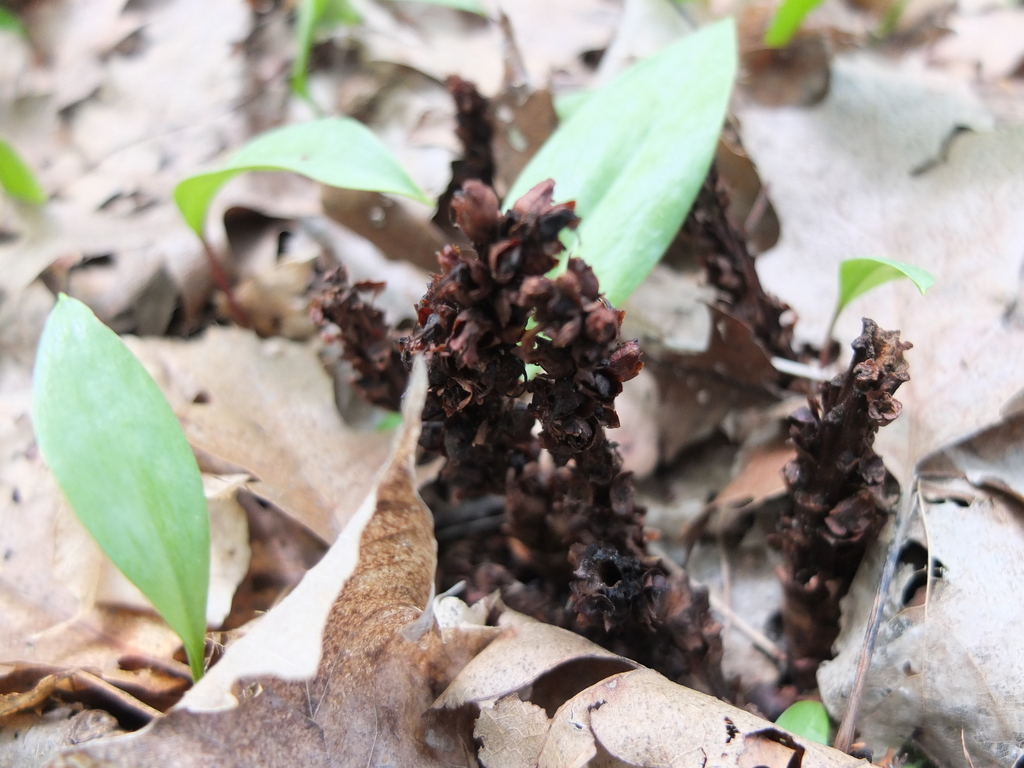
The next natural bizarrity we’ll look at is American Cancer root. Unfortunately, I had to delete my photos of this to make room on my phone, so I’ll have to rely on Wikipedia and iNaturalist. So far I’ve only seen it in the desiccated form below:

https://www.inaturalist.org/observations/4950105 Thanks to wdvanhem

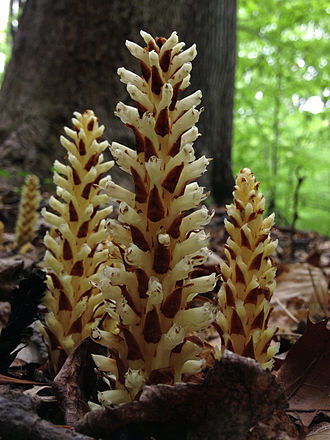
But in full “bloom” it looks more like this, justifying it’s other name “Bear Corn”

https://en.wikipedia.org/wiki/Conopholis_americana

It is technically a plant, although it does not photosynthesize (!?), being fully parasitic on the roots of Oak and Beech trees. The name is hard to explain, other than that it’s strange and parasitic, and so is cancer.

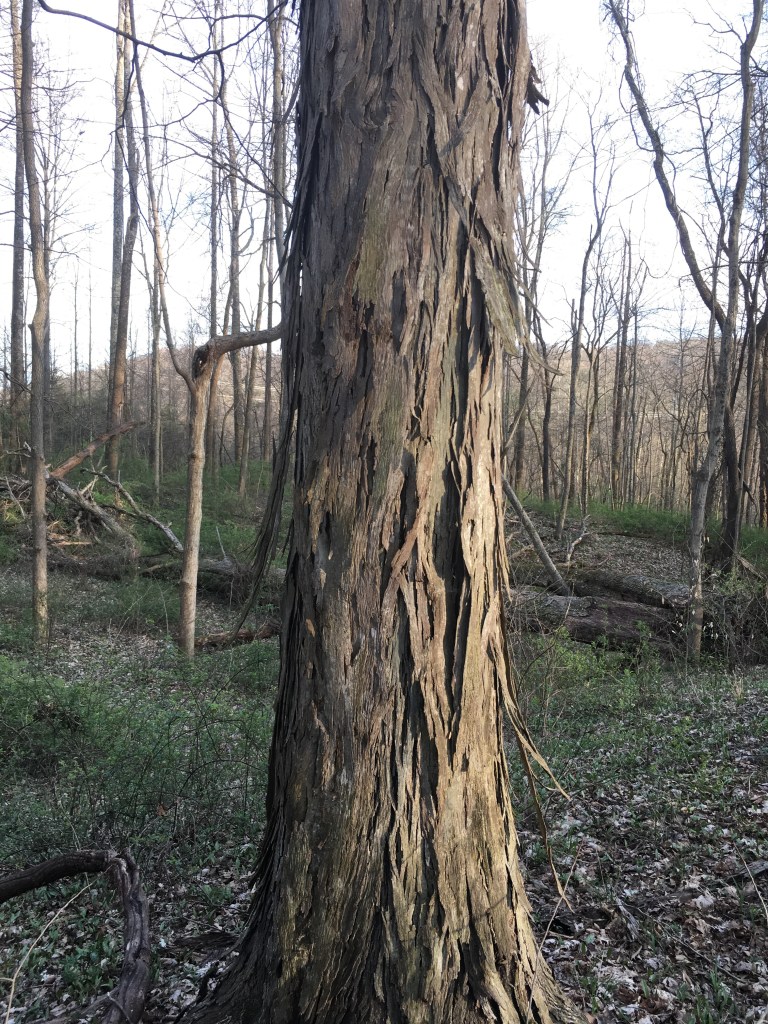
Last but not least, one of the most recognizable Indiana trees: the Shagbark Hickory.

What is the evolutionary advantage of this crazy bark? I don’t know. What I do know is that it’s pretty unique, perhaps even bizarre.

Three Spring Wildflowers

My first Indiana Spring has come and given me a chance to learn some new wildflowers. Above you see one of my favorites, cleft phlox. Below we’ll talk about three more!

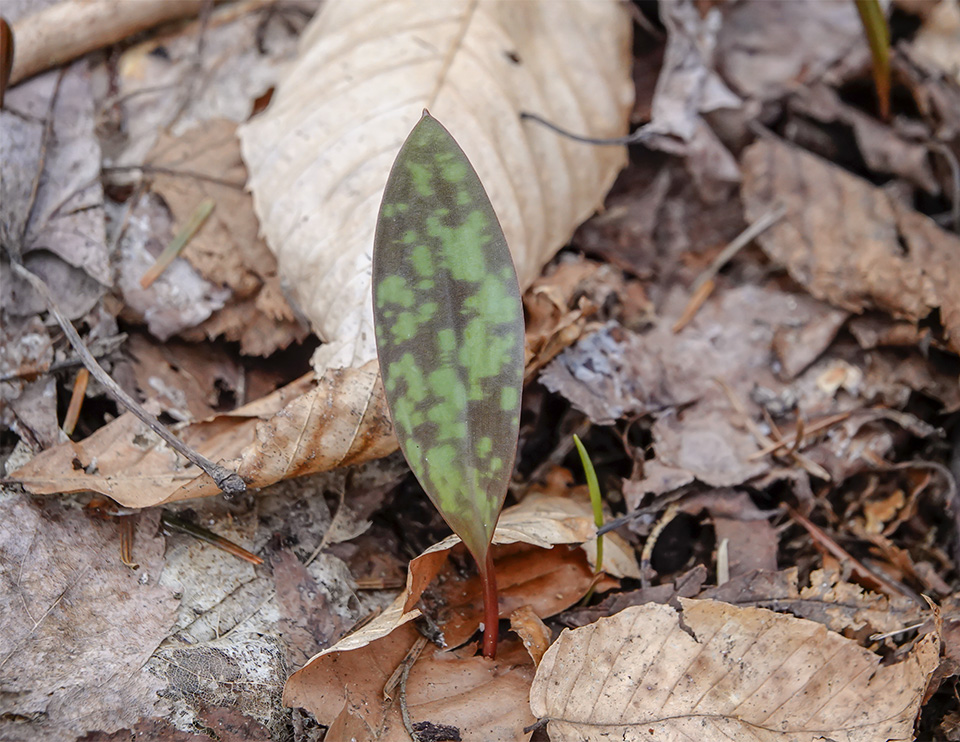
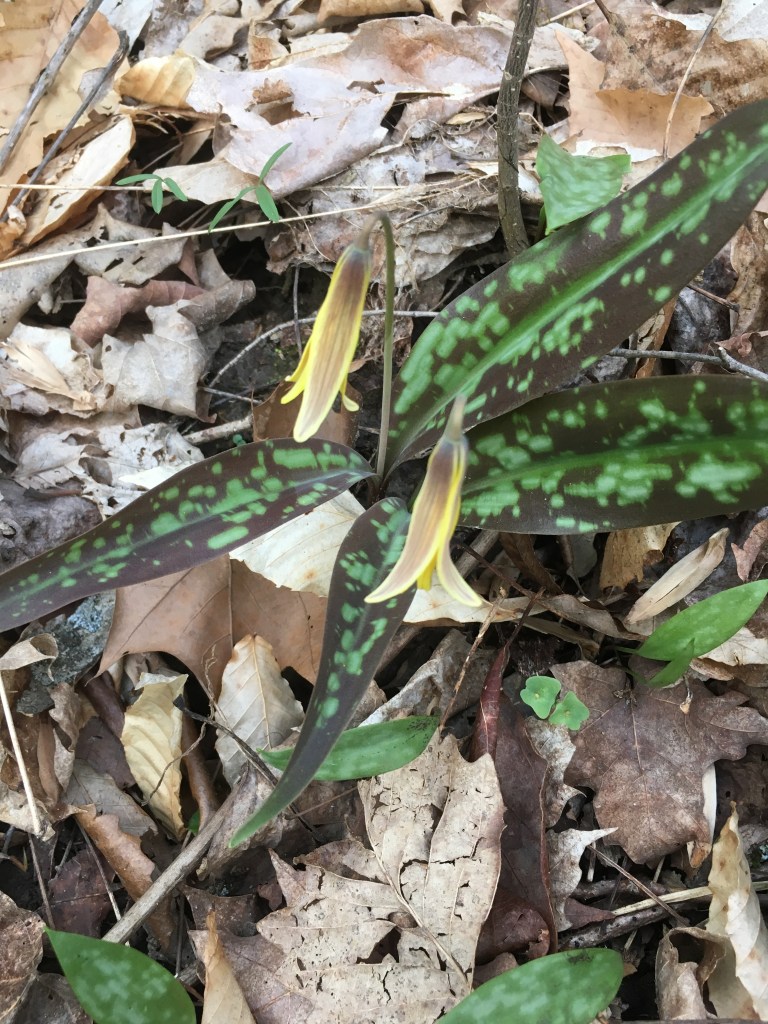
First up, the yellow trout lily. Called a “trout” lily because its leaves are mottled, or perhaps “dappled,” in a vaguely trout-like way. Yellow trout lilies grow in big colonies, which can live for hundreds of years and only a small percentage of which actually flower. The non-flowering form consists of a single leaf, which I find kind of bizarre:

https://wildadirondacks.org/adirondack-wildflowers-trout-lily-erythronium-americanum.html

For the first years of their lives yellow trout lilies don’t flower, they just spring up early in the spring, grab all the sunlight and still-nutrient-rich soil they can, and then coast the rest of the year. The flowering members of the colony use the same early-growth strategy. In the summer they wilt and retreat into their bulbs, or maybe “corms” is the correct term. This makes them a type of “spring ephemeral,” like Dutchman’s breeches which we will discuss later. Also, they’re not especially dependent on sexual reproduction for propagation. Colonies of trout lilies can expand asexually, through “droppers,” which are essentially shoots the parent bulb sends out which then disconnect from the parent bulb and become their own bulb.

You can see towards the bottom some of the younger, single-leaved members of the colony.

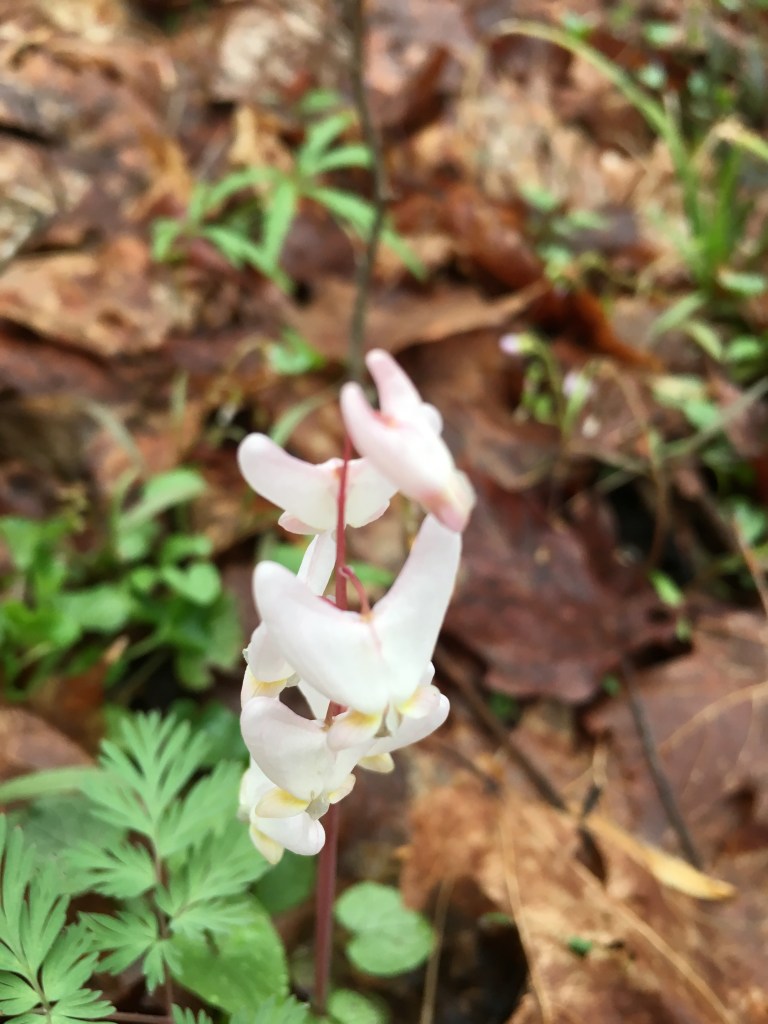
The second wildflower we will look at is Dutchman’s Breeches. Like Yellow trout lilies, Dutchman’s Breeches seeds have elaiosomes, which are little nutrient rich structures attached to the seed which attract ants, who then carry the seeds, elaiosomes and all, back to their mounds, dispersing the seeds in the process. Neat huh?

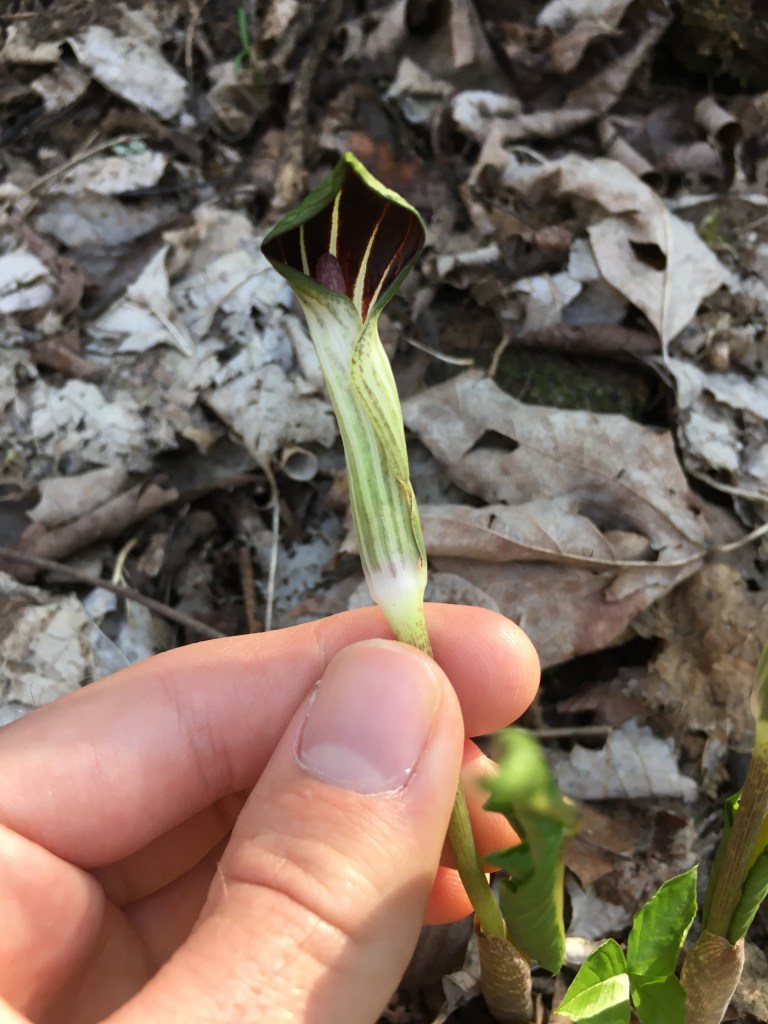
Lastly, lets take look at another wildflower with a great name, Jack in the Pulpit. This hooded flower has a lot of personality and an interesting way of reproducing. It attracts gnats, which are able to escape the male flowers carrying their pollen, but are trapped by the female flowers. Jack in the Pulpit is toxic, and its corms (bulb-like storage organs) were apparently used by the Meskwaki as poison. This time of year the leaves are not yet fully unfolded, so I’ll have to check these guys out later in the year to see their fully mature state:

The Selected Letters of Ralph Ellison: A reader’s thoughts

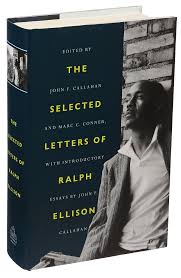
I am finding The Selected Letters of Ralph Ellison frustrating. Less the letters themselves, than the context in which they are presented. It feels to me like John F Callahan, Ellison’s literary executor, is, or is at least attempting to be, the owner of a monopoly on all things Ralph Ellison, which in a sense he legally is. What irritates me is what I might call the “monolithic” approach, or the “Great Man” approach. An imitation of something like Richard Ellmann’s Joyce, in which a single voice purports to be all: biographer, critic, friend (I know Joyce and Ellmann weren’t friends, but we are to believe that they might easily have been).

I don’t know what Callahan’s relationship to Ellison was, or how he came to be literary executor. But it seems to me problematic for one man to so dominate a writer’s posthumous existence as Callahan does Ellison’s. Callahan has published more Ellison than Ellison ever did in his own life. I have no doubt he has tried to be as faithful as possible to Ellison’s own wishes, but that is exactly the problem: that one reader of Ellison has gotten to “play” Ellison before the rest of us, pretending as if Ellison weren’t dead, but had transmuted himself into a white man by the name of John F. Callahan.

As a result, there’s a lot left out of the picture. Admittedly, I’m no expert on Ellison’s life, but it’s clear the absences were just as potent as the presences. For example, were are Zora Neale Hurston and Toni Morrison and Gwendolyn Brooks? Were are women in general? Fanny is idolized as someone who “believes in him and his talent in a more unconditional way than he [himself] does.” More unconditional, because as a woman it is her “nature” to be unconditional, and leave rationality to mere men. His first wife, Rosie, is “impossible not to like” because “she is able to inspire a man such as Ralph Ellison.”

All I’m saying is that a more diverse range of opinion would make Ellison both more likable and more artistically valuable to the present day. No one loves to have a “genius” forced down their throat. I know that as the selected letters of Ellison it will necessarily prioritize his point of view. But is there a reason editors have to avoid all discordant context, as if the purity of an author’s artistic achievement would be contaminated by an opposing point of view?

Early Spring Photos: Indiana

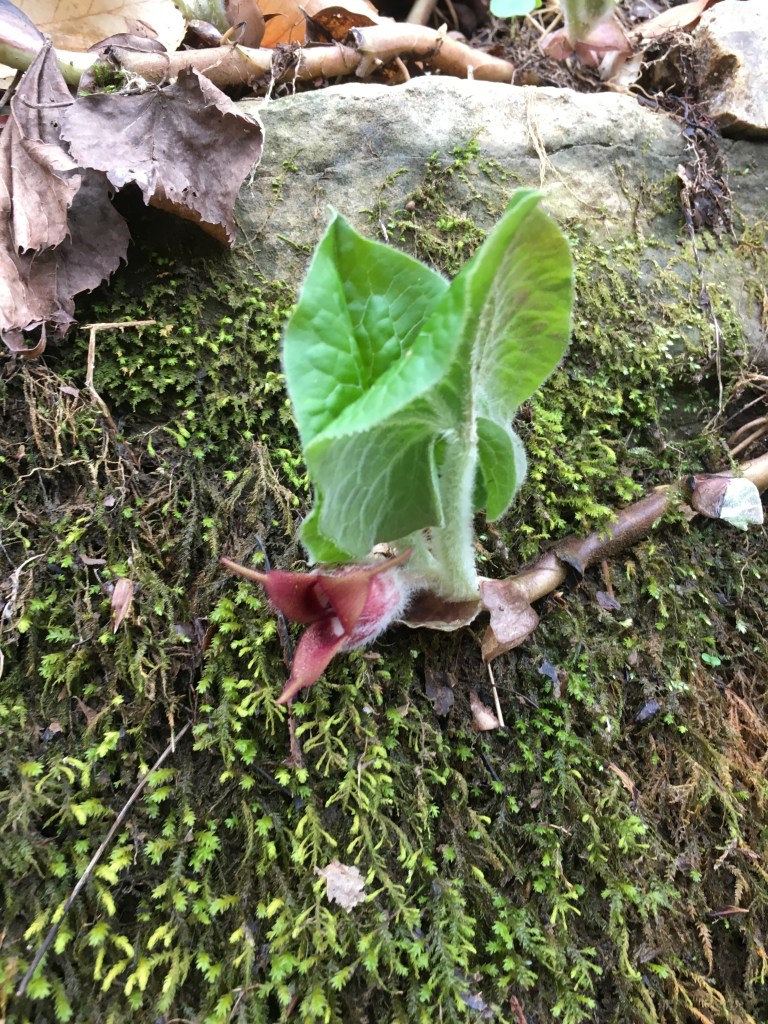
Canadian Wild Ginger. Dragon of the plant world.
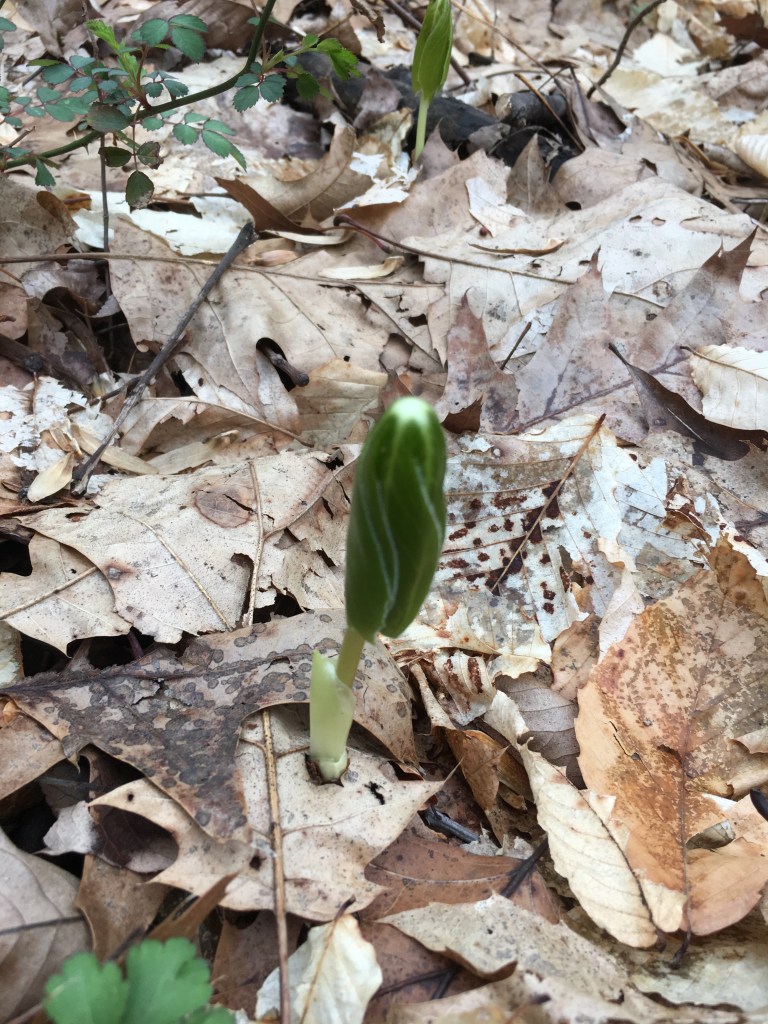
Mayapple shoots. Invasive Multiflora Rose in the top left.
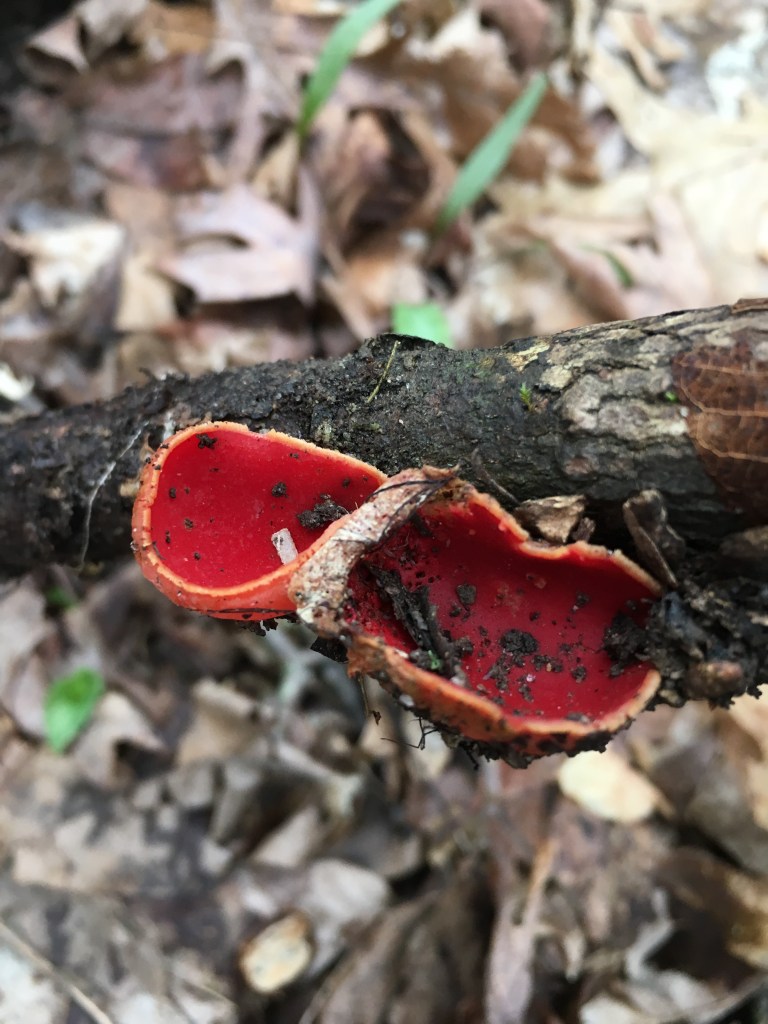
Scarlet Elfcup, one of the most brilliantly colored mushrooms!

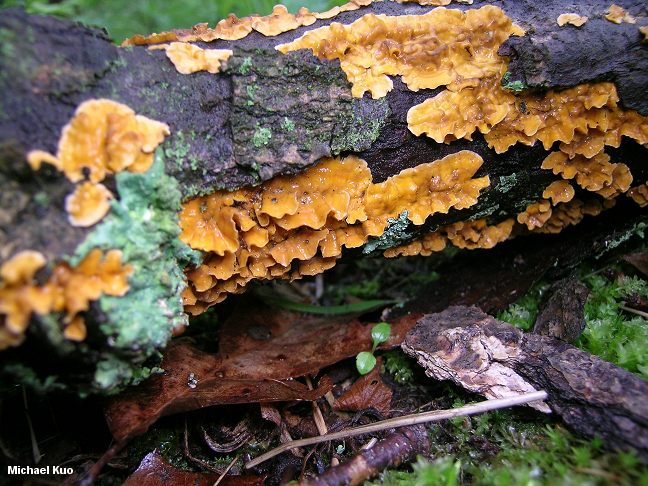
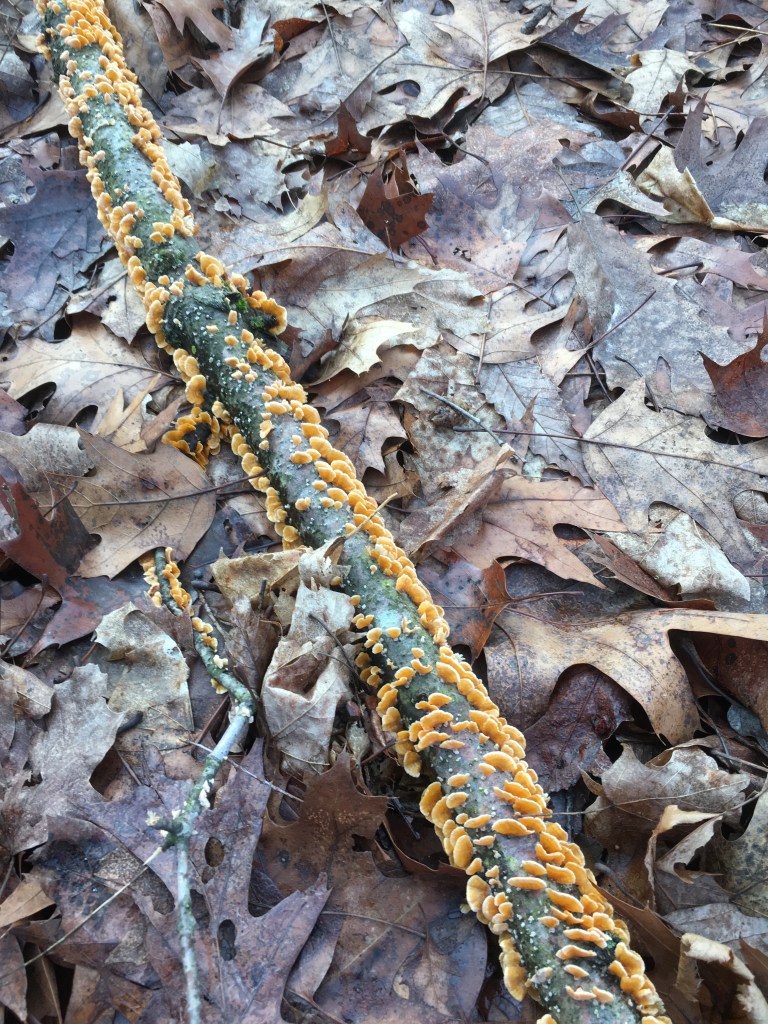
And now for an embarrassing story…the “corn flake mushroom,” as I called it in my head, turns out to be, after months of frustrating research (well, really just hours over the course of a couple months) the extremely common… Crowded Parchment Fungus, considered by mushroomexpert.com to be “the most common, ubiquitous, ever-present, lost-all-luster fungus among us.” Why was it so hard for me to identify such a common mushroom? Well, compare the picture on the left (from my mushroom book) with the photo I took:

In the picture from my book the caps are fused creating what looks like a crust fungus. In my sample, the caps are distinct, corn-flaky. Mushroom hunters beware: fungi are Protean!

“Murder Most Foul” and the Mean World Syndrome

A little while ago I watched a great documentary about the work of a professor at UPenn on the effect of TV violence. He found that TV violence did not make people more violent themselves, but that it led them to believe the world around them was more violent than it really was. Seeing thousands of brutal deaths on TV didn’t cause people to go out and commit brutal murders themselves, but it did heighten their fear that they themselves would be brutally murdered. Hence while actual crime has dropped, a paranoid fight or flight need to defend oneself aggressively, as for instance by stocking up on automatic weapons, invading Iraq, or building a wall, has spread. For more info check out: https://en.wikipedia.org/wiki/Mean_world_syndrome or watch the documentary itself.

It is in this light I want to look at violence in the songs of Bob Dylan, and in “Murder Most Foul” specifically. How does Bob Dylan’s use of violence differ from or overlap with that of TV? And to what extent has his worldview been colored by TV violence?

First of all, “Murder Most Foul” is far from the first Dylan song to concern itself with, even be obsessed with, violence. Starting with Blood on the Tracks, and receiving a major lift from the Biblical violence of born-again Dylan, Dylan’s material has become progressively more violent over time. Tempest is probably his most gory album to-date. Even what seems like a love-song, “Soon After Midnight,” includes lines like “I’ll drag his corpse through the mud.” Then there’s “Pay in Blood,” in which the persona states “I got dogs could tear you limb from limb,” and “Scarlet Town,” presumably also a reference to blood.

Could Bob Dylan have a case of the Mean World Syndrome? I mean what in his personal experience can have convinced him that the world was that vicious? Was it the televised assassination of JFK or the general media violence of the 60s taken all together? How much TV does Dylan watch? Does he watch the local crime report? I wouldn’t be that surprised if he did. Or does his sense of a violent world have more in common with literary sources, like the Bible or Shakespeare?

Violence is certainly pervasive in Dylan’s aesthetic world. But more often than not, violence is portrayed as tragic or senseless or stupid. The frequency of the word “blood” in his work points to this. Blood is something “lost,” it’s a wound, it connotes a tragic type of violence, that is, something finished and done with, something brutally taken away, it suggests the victim rather than the aggressor. Violence in Dylan is nearly always ugly. In this sense it’s different from TV violence, which usually focuses on the winner, and on the act of violence itself rather than the aftermath.

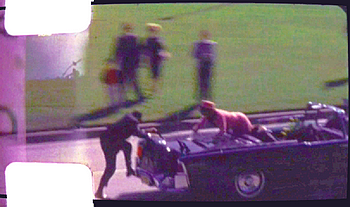
What’s unique about “Murder Most Foul” is the way it concerns media violence, specifically the famous Zapruder film, which the persona has watched “33 times maybe more.” Interestedly, the lines:

It’s vile and it’s deceitful, it’s cruel and it’s mean

It’s the ugliest thing that you ever have seen

seem to refer not to the act of violence itself, but to the film capturing it. Whereas in the Tempest songs, for example, the violence is a part of a fictional world in which the persona situates himself as someone who acts, in “Murder Most Foul,” the emphasis is on the act of seeing, the experience of the persona as witness. It’s a song less about violence itself, and more about living in a violent world.

I don’t think I’m going to be able to answer the questions I initially set. After all discussions about differences in media, TV vs. song vs. book, take up whole bookshelves let alone books. And we have no way of knowing (except through tiny chinks in the armor) whether or not TV violence has impacted Dylan’s worldview. But I do find the similarities between a general American obsession with a violent external world (consider the Western!) and Dylan’s private cosmos of violence intriguing. I also think “Murder Most Foul” takes a somewhat more sensitive and personal approach to violence than most previous Dylan songs. There is more emphasis on the witness, a greater openness to personal vulnerability. Perhaps it was a sort of exorcism (it does have an incantatory aspect) to drive a certain traumatic demon out. But if so, I doubt that demon will stay out for long.

Will there be blood?

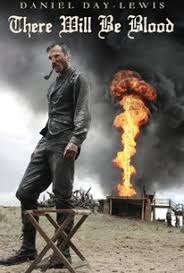
There Will be Blood is a piece of myth-making about America and about masculinity. The myth it tells about America is that it is the product of fanatical individuality, the fierce will of the strongest, that the problems with our society stem not from something systemic or collective, but from the tragic flaws of great men. The myth it tells about masculinity is that it must, and can, be bought at the price of blood.

On the one hand you may say that the movie clearly does not approve of Daniel’s behavior. And on the surface that is true. But that Daniel Plainview is obviously destructive and miserable does not make him less idealized. All “great” heroes and geniuses are “flawed,” but those “flaws,” far from weakening the admiration due to them, increase it. In other words, Daniel is not the hero of the story despite being violent and destructive, but because he is so.

There Will be Blood sends two messages, one avowed and the other implicit. The overt message is that boundless competitiveness is ultimately destructive. The implicit message is that that destructiveness is a confirmation of manhood, which is nearly synonymous with greatness/Americanness. The epic form of the 2 and half hour long Western, overpowers and uses for it’s own ends the original satiric kernel of content. Of all genres, the epic and the satire are perhaps least capable of symbiosis.

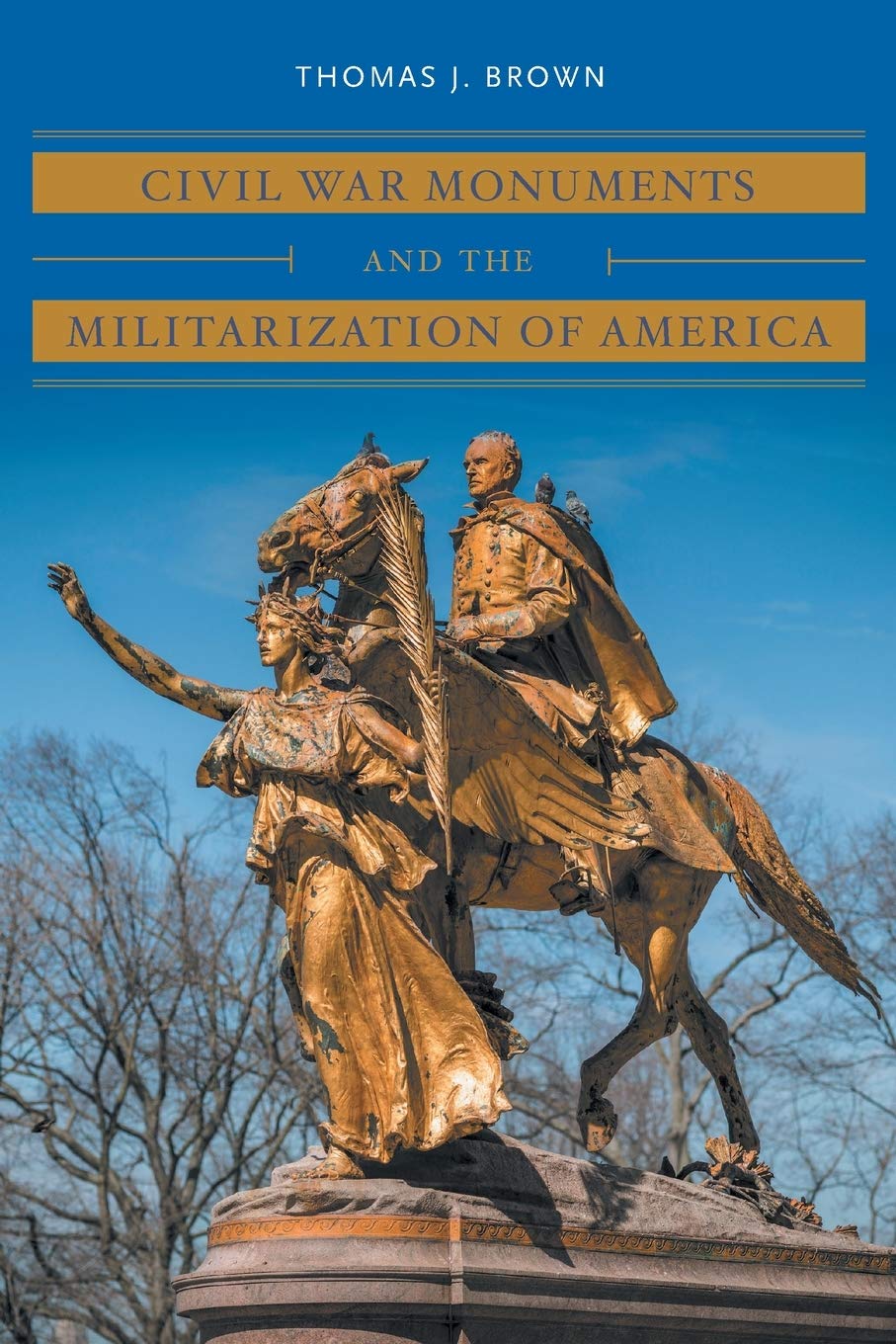
This reading of There Will be Blood ties into something else I am reading, Civil War Monuments and the Militarization of America, by Thomas Brown, which is about the emergence of the American martial ideal. There Will be Blood begins in 1898, the year of the Spanish-American War and close to the epicenter of the emergence of the soldier as paradigmatic American citizen.

As Thomas Brown explains, the emergence of this ideal was tied to two powerful forces of the day. One was the Grand Army of the Republic, G.A.R., a fraternal organization of Union veterans with considerable political clout (consider what enormous percentage of the all-male electorate would have been veterans in the decades after the Civil War). And the other was industrialization. Gilded Age magnates such as Andrew Carnegie (who paid someone to serve in his stead during the Civil War) propagated the citizen-soldier as model of the paradigmatic American because it reinforced the workplace mentality/hierarchy profitable to their business, and because it was the National Guard which had to be called in to enforce their working conditions by putting down strikes.

All this to say, that while There Will be Blood is a well-made and powerful piece of epic mythification, it brings nothing new to our picture of America or of manhood.

National Guard moving to disperse strikers. Andrew Carnegie and the Homestead Strike. 1892

War with the Newts

I have just finished reading Válka s mloky (War with the Newts) to keep up my Czech. Čapek wrote the novel in four months, and it took me almost that long to read it. As reading practice for a non-native speaker, it is perfect because a lot of different vocabulary comes up: economic, historical, political, scientific, comedic etc… and the style changes frequently which prevents it from becoming monotonous. In my opinion however the novel becomes less and less “tight” as it progresses. The first book “Andrias Scheuchzeri” was the funniest, and presents in outline the concept of the whole book. I almost think that if one was short on time, or reading the book as part of a class, the first book (156 pages) would be enough.

The primary question of interpretation is what do the “mloky,” the newts, represent, if anything? My first thought was that they stood for exploited humanity. They represented the slaves of all time. But this would be rather insulting to the victims of human slavery, to portray them as animals, who, throughout the whole book, though they learn to speak, never express themselves or develop their own culture. Rather, they are presented as a homogenous, terrifying mass.

My second thought was that they represented a supernatural, or more accurately, a superhuman force, perhaps the force of Nature herself, who had risen up to chastise a humanity which had overstepped its bounds. The problem with this is that Čapek explicitly stated that the demise of humanity in the book was not due to a “cosmic catastrophe” but to quotidian reasons of “state, economics and prestige.” Čapek meant to portray humanity’s self-destruction as just that, self-destruction, but in that case what meaning do the newts have, why are they necessary to story at all?

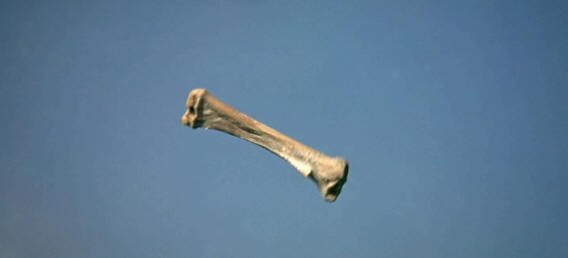
So then perhaps the newts represent some leaven of self-destructiveness within humanity itself? Or do they represent nothing at all, but are just a neutral tool that happened to be there, like in the opening scene of 2001: A Space Odyssey :

But now that I’ve thought about it, I think the newts represent the dehumanized humanity Čapek saw industrial Capitalism as creating. Necessities of profit, expansion, and power create a de-individualized humanity ripe for totalitarian control. The newts, who are initially portrayed sympathetically, gradually become an anonymous and insatiably expanding mass as they are turned to profit by state and industrial greed. This dehumanized mass, created by the machinery of Capitalism, is then in turn especially vulnerable to ideologies such as Fascism or Communism (never explicitly mentioned in the book).

Again here, though, there is the problem of the objectification of the victim, which I’m not sure Čapek thought about.

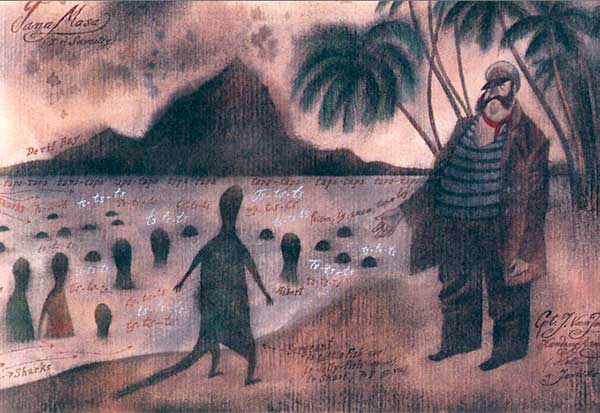
Captain Van Toch discovers his “tapa boys.” Scene from the beginning of the book.

Notes on “Civil War Monuments and the Militarization of America”

Since the beauty of this book lies in the specifics, rather than try to somehow present a coherent summary in the form of an essay, I am simply giving as bullet points facts that struck me so far.

Americans initially thought of themselves as peaceable in contrast to Imperial Britain with it’s global empire and professional army. The paradigm of the American was the farmer or the craftsman, who was seen as representing industrious virtue, whereas the professional solider was emblematic of illegitimate authority and idleness/loose virtue (cards, drinking, women—like soldiers in 18th and 19th century novels). The situation now is the extreme opposite. Soldiers today represent the pinnacle of discipline and citizenship, Abu Ghraib notwithstanding.

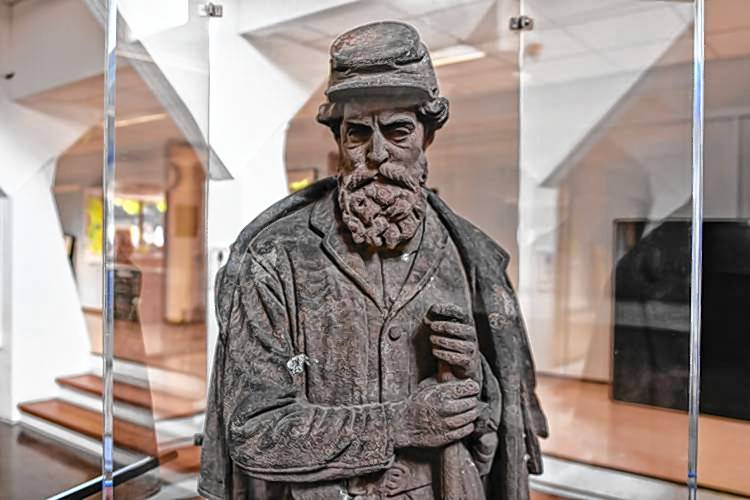
As an example of changing attitudes towards military service, we can compare two types of Civil War monuments. One, erected mostly in the more immediate aftermath of the war, shows the solider mourning or at rest. The emphasis is on sentiment, war as tragedy, aberration. For example, this one from 1867

The Civil War statue of a soldier now resides in a plastic box at the Deerfield Town Offices.

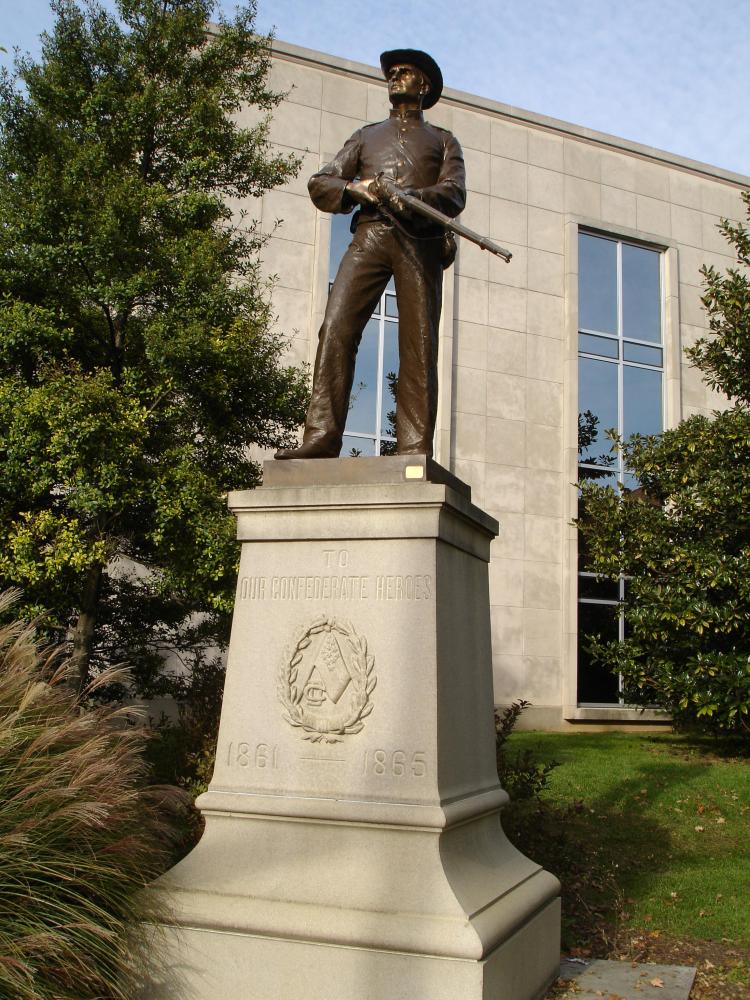
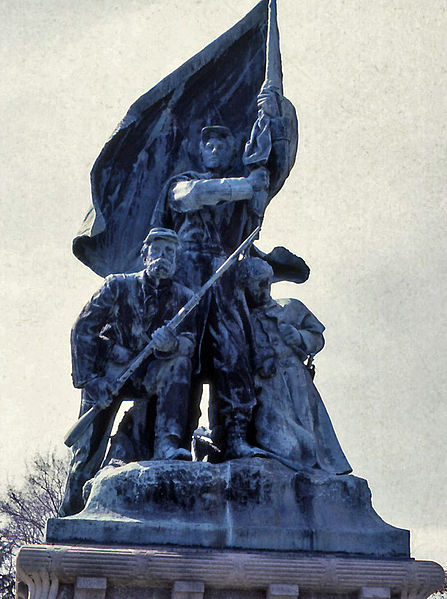
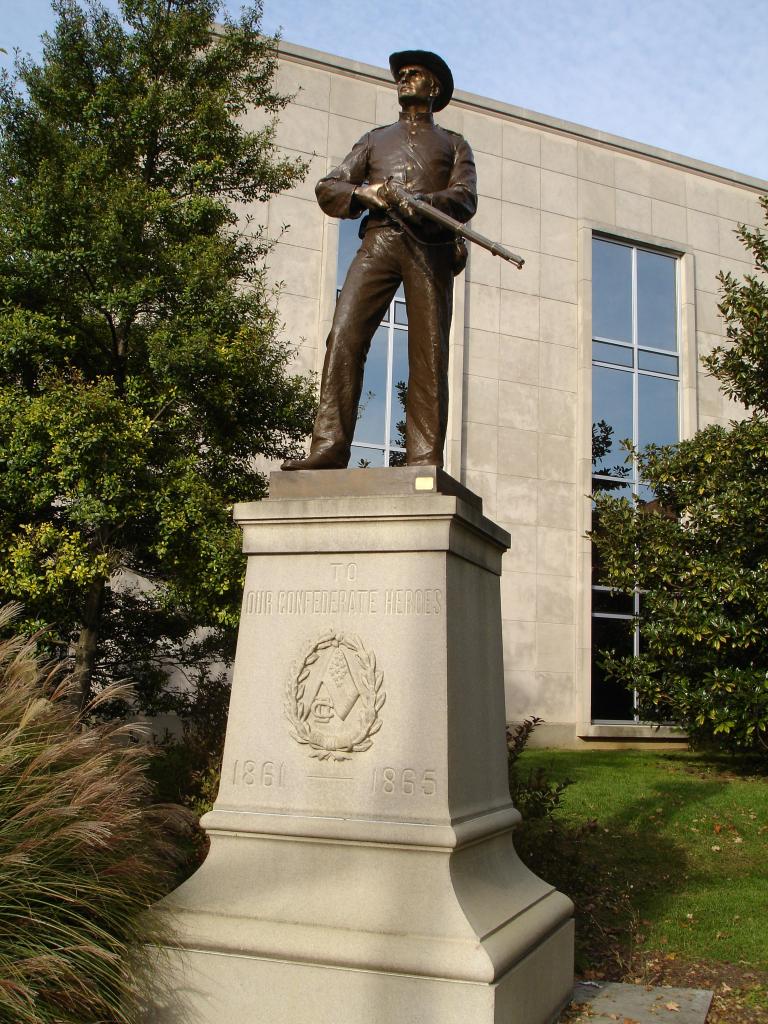
The second, later, type focuses on the soldier as soldier; alert and active, not as someone who is experiencing war but as someone who is participating in it. This is true both of confederate and Union statues.

What happened in between? … I’ve still got some reading to do.

Design a site like this with WordPress.com
Get started