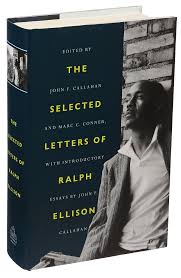
I am finding The Selected Letters of Ralph Ellison frustrating. Less the letters themselves, than the context in which they are presented. It feels to me like John F Callahan, Ellison’s literary executor, is, or is at least attempting to be, the owner of a monopoly on all things Ralph Ellison, which in a sense he legally is. What irritates me is what I might call the “monolithic” approach, or the “Great Man” approach. An imitation of something like Richard Ellmann’s Joyce, in which a single voice purports to be all: biographer, critic, friend (I know Joyce and Ellmann weren’t friends, but we are to believe that they might easily have been).
I don’t know what Callahan’s relationship to Ellison was, or how he came to be literary executor. But it seems to me problematic for one man to so dominate a writer’s posthumous existence as Callahan does Ellison’s. Callahan has published more Ellison than Ellison ever did in his own life. I have no doubt he has tried to be as faithful as possible to Ellison’s own wishes, but that is exactly the problem: that one reader of Ellison has gotten to “play” Ellison before the rest of us, pretending as if Ellison weren’t dead, but had transmuted himself into a white man by the name of John F. Callahan.
As a result, there’s a lot left out of the picture. Admittedly, I’m no expert on Ellison’s life, but it’s clear the absences were just as potent as the presences. For example, were are Zora Neale Hurston and Toni Morrison and Gwendolyn Brooks? Were are women in general? Fanny is idolized as someone who “believes in him and his talent in a more unconditional way than he [himself] does.” More unconditional, because as a woman it is her “nature” to be unconditional, and leave rationality to mere men. His first wife, Rosie, is “impossible not to like” because “she is able to inspire a man such as Ralph Ellison.”
All I’m saying is that a more diverse range of opinion would make Ellison both more likable and more artistically valuable to the present day. No one loves to have a “genius” forced down their throat. I know that as the selected letters of Ellison it will necessarily prioritize his point of view. But is there a reason editors have to avoid all discordant context, as if the purity of an author’s artistic achievement would be contaminated by an opposing point of view?
 recycled paper clips