A little while ago I watched a great documentary about the work of a professor at UPenn on the effect of TV violence. He found that TV violence did not make people more violent themselves, but that it led them to believe the world around them was more violent than it really was. Seeing thousands of brutal deaths on TV didn’t cause people to go out and commit brutal murders themselves, but it did heighten their fear that they themselves would be brutally murdered. Hence while actual crime has dropped, a paranoid fight or flight need to defend oneself aggressively, as for instance by stocking up on automatic weapons, invading Iraq, or building a wall, has spread. For more info check out: https://en.wikipedia.org/wiki/Mean_world_syndrome or watch the documentary itself.
It is in this light I want to look at violence in the songs of Bob Dylan, and in “Murder Most Foul” specifically. How does Bob Dylan’s use of violence differ from or overlap with that of TV? And to what extent has his worldview been colored by TV violence?
First of all, “Murder Most Foul” is far from the first Dylan song to concern itself with, even be obsessed with, violence. Starting with Blood on the Tracks, and receiving a major lift from the Biblical violence of born-again Dylan, Dylan’s material has become progressively more violent over time. Tempest is probably his most gory album to-date. Even what seems like a love-song, “Soon After Midnight,” includes lines like “I’ll drag his corpse through the mud.” Then there’s “Pay in Blood,” in which the persona states “I got dogs could tear you limb from limb,” and “Scarlet Town,” presumably also a reference to blood.
Could Bob Dylan have a case of the Mean World Syndrome? I mean what in his personal experience can have convinced him that the world was that vicious? Was it the televised assassination of JFK or the general media violence of the 60s taken all together? How much TV does Dylan watch? Does he watch the local crime report? I wouldn’t be that surprised if he did. Or does his sense of a violent world have more in common with literary sources, like the Bible or Shakespeare?
Violence is certainly pervasive in Dylan’s aesthetic world. But more often than not, violence is portrayed as tragic or senseless or stupid. The frequency of the word “blood” in his work points to this. Blood is something “lost,” it’s a wound, it connotes a tragic type of violence, that is, something finished and done with, something brutally taken away, it suggests the victim rather than the aggressor. Violence in Dylan is nearly always ugly. In this sense it’s different from TV violence, which usually focuses on the winner, and on the act of violence itself rather than the aftermath.
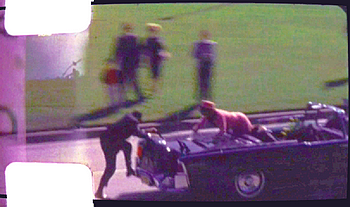
What’s unique about “Murder Most Foul” is the way it concerns media violence, specifically the famous Zapruder film, which the persona has watched “33 times maybe more.” Interestedly, the lines:
It’s vile and it’s deceitful, it’s cruel and it’s mean
It’s the ugliest thing that you ever have seen
seem to refer not to the act of violence itself, but to the film capturing it. Whereas in the Tempest songs, for example, the violence is a part of a fictional world in which the persona situates himself as someone who acts, in “Murder Most Foul,” the emphasis is on the act of seeing, the experience of the persona as witness. It’s a song less about violence itself, and more about living in a violent world.
I don’t think I’m going to be able to answer the questions I initially set. After all discussions about differences in media, TV vs. song vs. book, take up whole bookshelves let alone books. And we have no way of knowing (except through tiny chinks in the armor) whether or not TV violence has impacted Dylan’s worldview. But I do find the similarities between a general American obsession with a violent external world (consider the Western!) and Dylan’s private cosmos of violence intriguing. I also think “Murder Most Foul” takes a somewhat more sensitive and personal approach to violence than most previous Dylan songs. There is more emphasis on the witness, a greater openness to personal vulnerability. Perhaps it was a sort of exorcism (it does have an incantatory aspect) to drive a certain traumatic demon out. But if so, I doubt that demon will stay out for long.
 recycled paper clips
I agree with you about the incantatory nature of “Murder Most Foul.” I found it hypnotic, the way he set up this rhythm and kept at it for what, 13 minutes? It reminded me of “Duquesne Whistle,” which imitates a train on tracks. Incantations can convince people to do terrible things, but they can also calm down violent impulses, and I’m sure Dylan is exploring those two potentially opposing aspects.
LikeLike