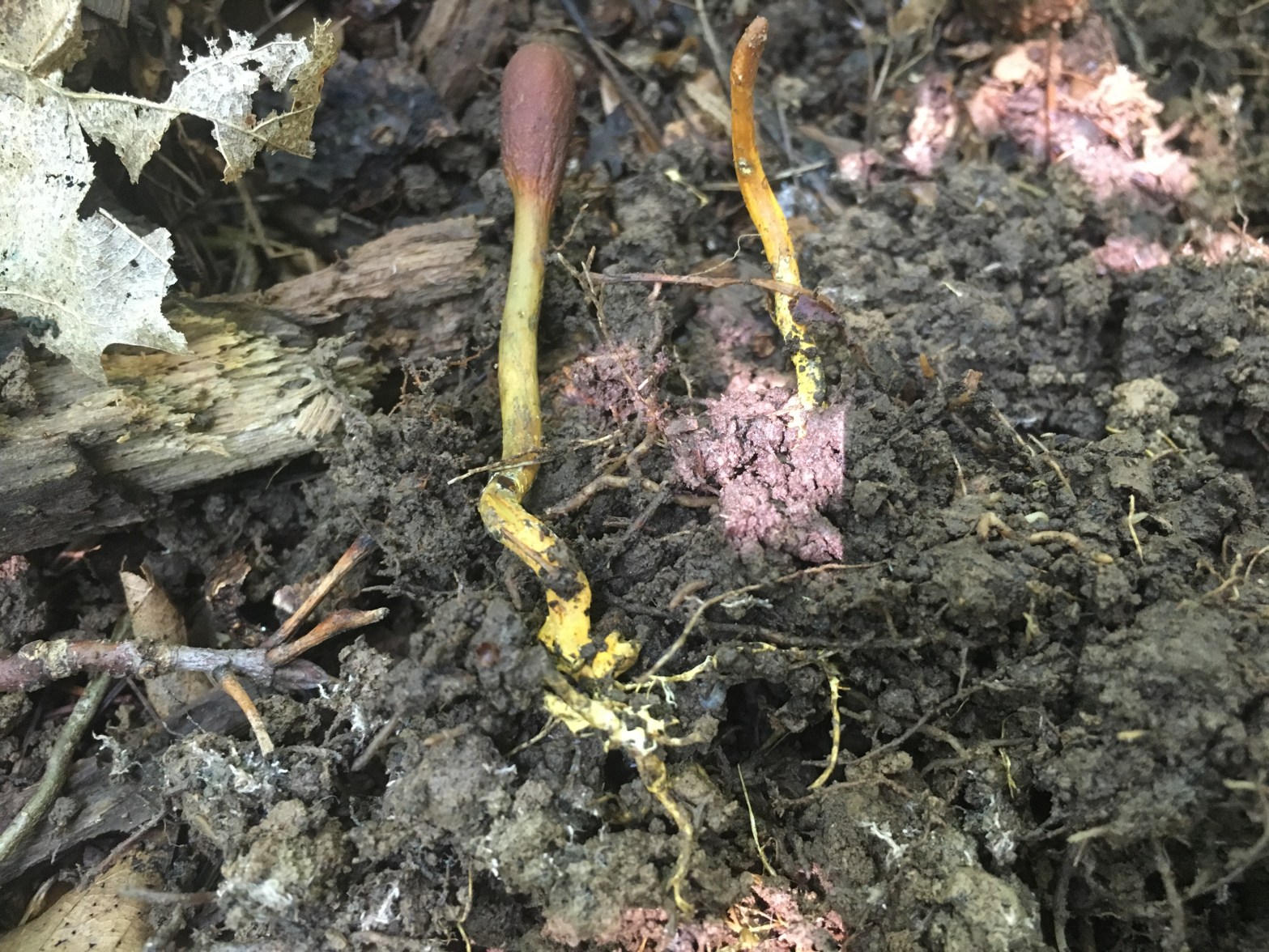
Last week, as I was sitting down to photograph a small field of deliquescing Ochre Jelly Babies, I noticed a large matchstick looking club fungus sticking up out of the ground. My first thought was that it was one of the famous Cordyceps mushrooms which parasitize insects, for instance by hijacking the brains of certain wasps and causing them to climb high into the canopy, where they die and spread the fungus’s spores far and wide.
With this in mind, I was very careful to dig out underneath the mushroom in the hopes of finding an insect carcass (see Cordyceps militaris). This is not what I found, but I did find something just as interesting.
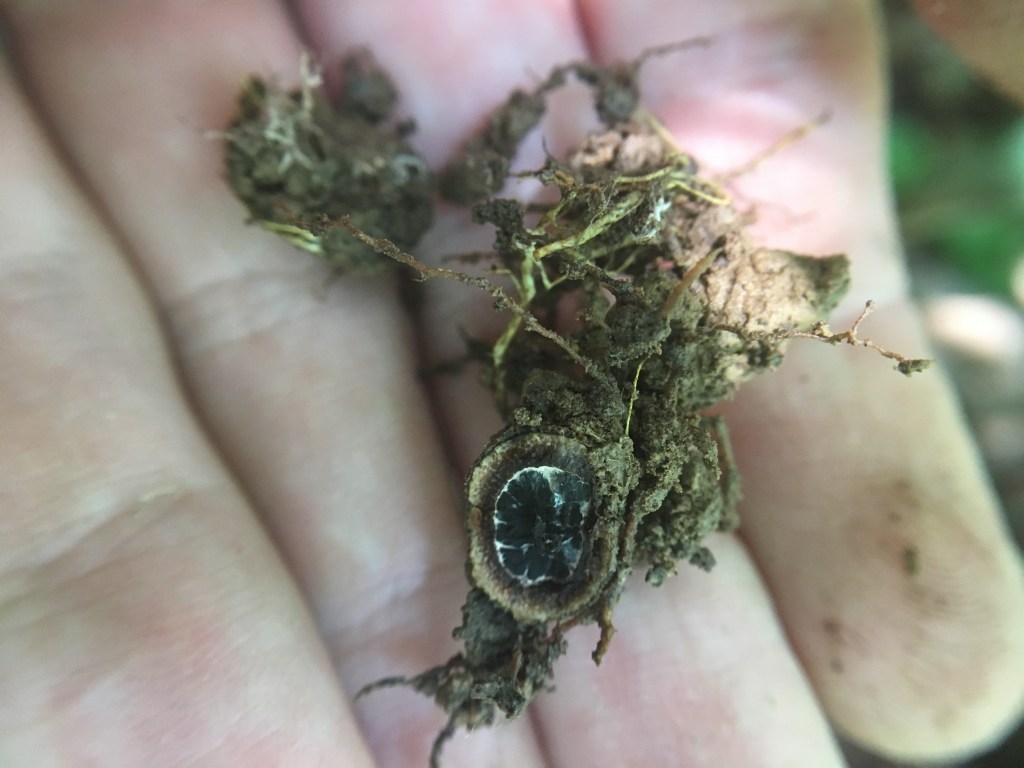
What I found was a small truffle-like fungus that the club fungus was growing from. When I researched this at home I learned that the club fungus I found was Tolypocladium ophioglossoides (also known as the “goldenthread cordyceps” or, what I think is more accurate since it doesn’t actually belong to the genus Cordyceps, the snaketongue truffleclub) which parasitizes truffle-like fungi called Elaphomyces.
This brought up a lot of questions about truffles and truffle-like fungi. Here is some of what I learned:
- underground mushrooms have evolved from the typical cap and stem mushroom on many many separate occasions, a classic instance of convergent evolution.
- “True” truffles belong to the genus Tuber which in turn belongs to the phylum Ascomycota (along with morels and other cup fungi). Most cap and stem mushrooms belong to the phylum Basidiomycota.
- But, truffle-like mushrooms have evolved many many times within Basidiomycota as well. Classic above-ground fungi like agarics, boletes, russulas, chanterelles, have closely related underground cousins, considered “false truffles.”
- The reason that so many fungi have separately evolved underground fruiting bodies appears to be that it makes them less dependent on rain, as levels of moisture are more consistent underground. Truffle-like fungi therefore have an advantage in drought or low water conditions.
- Truffles and truffle-like fungi rely on animals to spread their spores, as they have no aboveground structure for wind dispersal.
- They therefore emit powerful attractants for squirrels, deer, etc… which eat the truffles and then spread their spores in their poop.
- The specific truffle-like fungus I found belongs to Ascomycota like the true truffles, but is not otherwise closely related.
- We can therefore break underground mushrooms into roughly three categories: true truffles (members of Tuber and close allies), false truffles (basidiomycetes more closely related to your standard cap and stem mushrooms than to true truffles), and truffle-like fungi (members of Ascomycota, but not closely related to truffles).
- Elaphomycetes, like the truffle-like fungus I found, are not generally edible to humans. But, as the common name “deer-truffles” suggests, they are edible to other animal species on which they depend for spore dispersal.
- Truffles, false truffles and truffle-like mushrooms are all mycorrhizal.

Sources:
 recycled paper clips