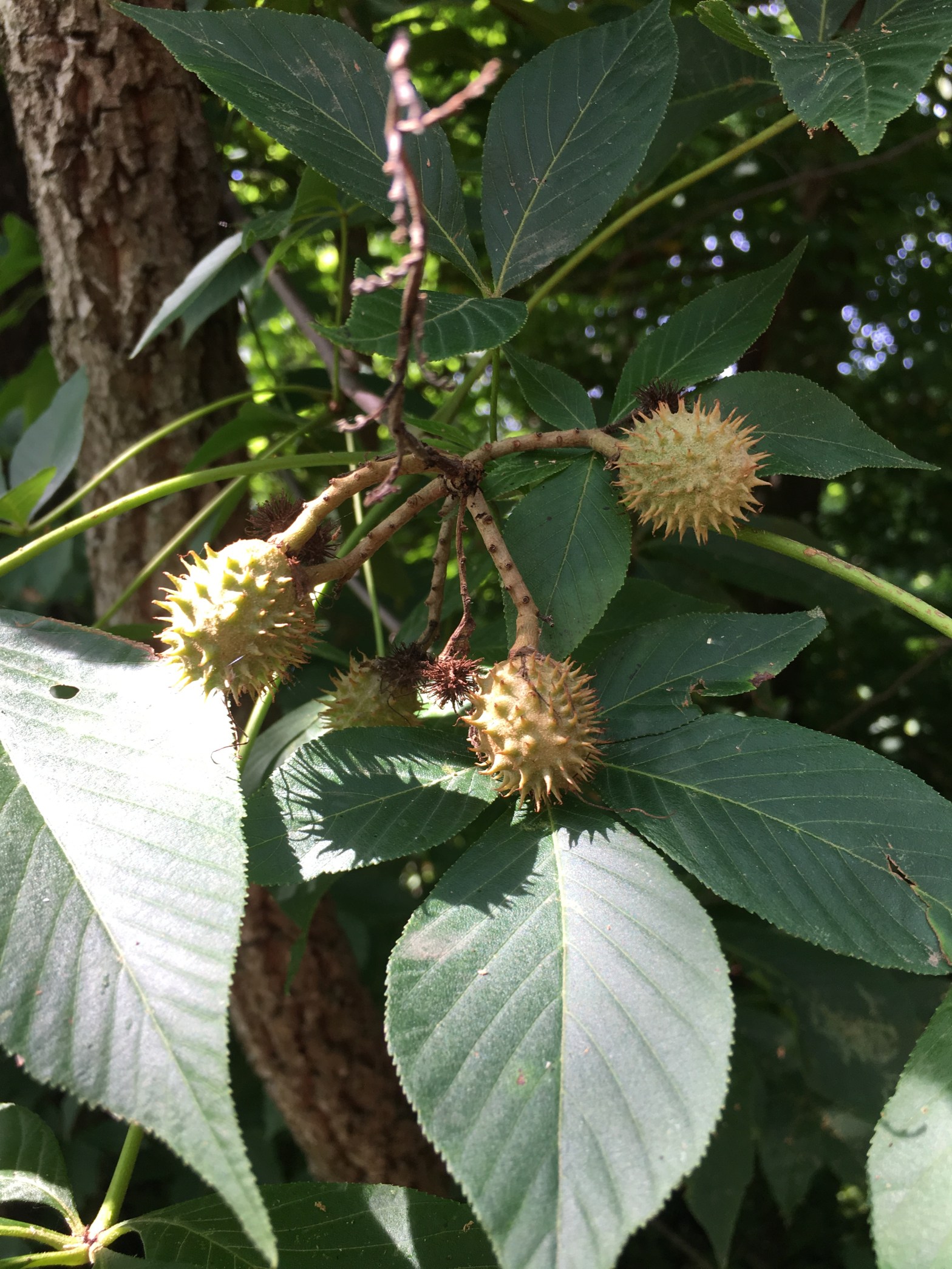
The Ohio Buckeye is a distinctively Midwestern tree, so much so that “buckeye” became a kind of metonym for the region and the early Anglo-American settlers thereof. The name “buckeye” itself needs explanation. The most commonly given one is that the shiny brown fruits resemble the eyes of a buck.
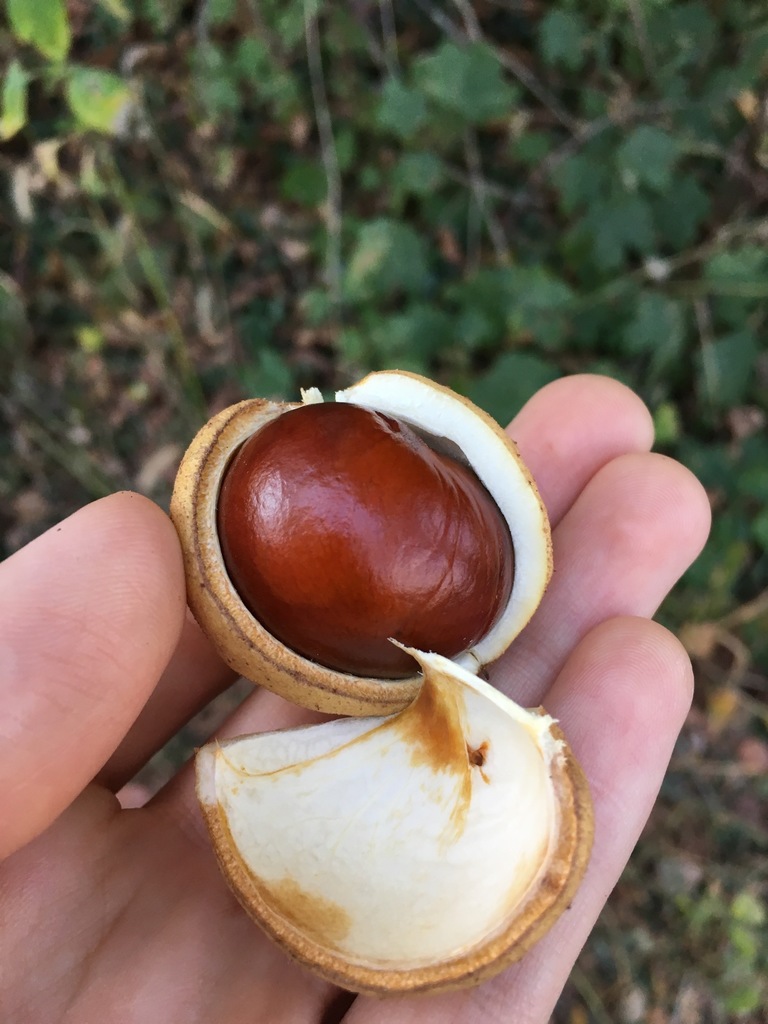
The Ohio Buckeye belongs to the genus Aesculus (commonly called Buckeyes and Horse-chestnuts) but it has no relation either to the ancient Greek playwright or the true chestnuts. In fact, it is in the same family as maples (which explains why they both have opposite branching), while chestnuts are part of the Beech family (which explains why Beech nuts look kind of like little chestnuts).
Buckeye nuts are poisonous because they contain lots of tannic acid. Interestingly though, tannic acid is approved by the FDA for use in “baked goods and baking mixes, alcoholic and non-alcoholic beverages, frozen dairy products, soft and hard candy, meat products, and rendered animal fat.1” Some Native Americans blanched buckeyes to remove the tannic acid (which can be used to make leather and to poison fish in streams) and then ate them2.
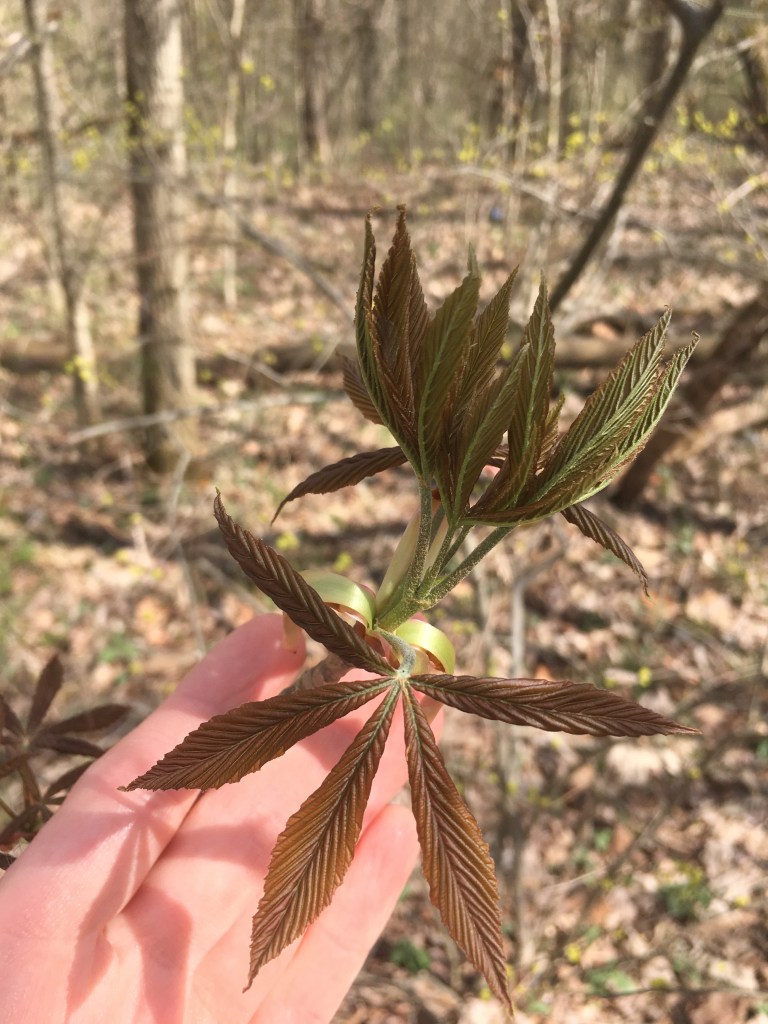
The distinctive identifying features of the Ohio Buckeye are the opposite branching, and the palmate leaves. Palmate meaning that several leaves radiate out from a single point, like fingers from a palm. They are one of the very first trees to leaf out in spring,
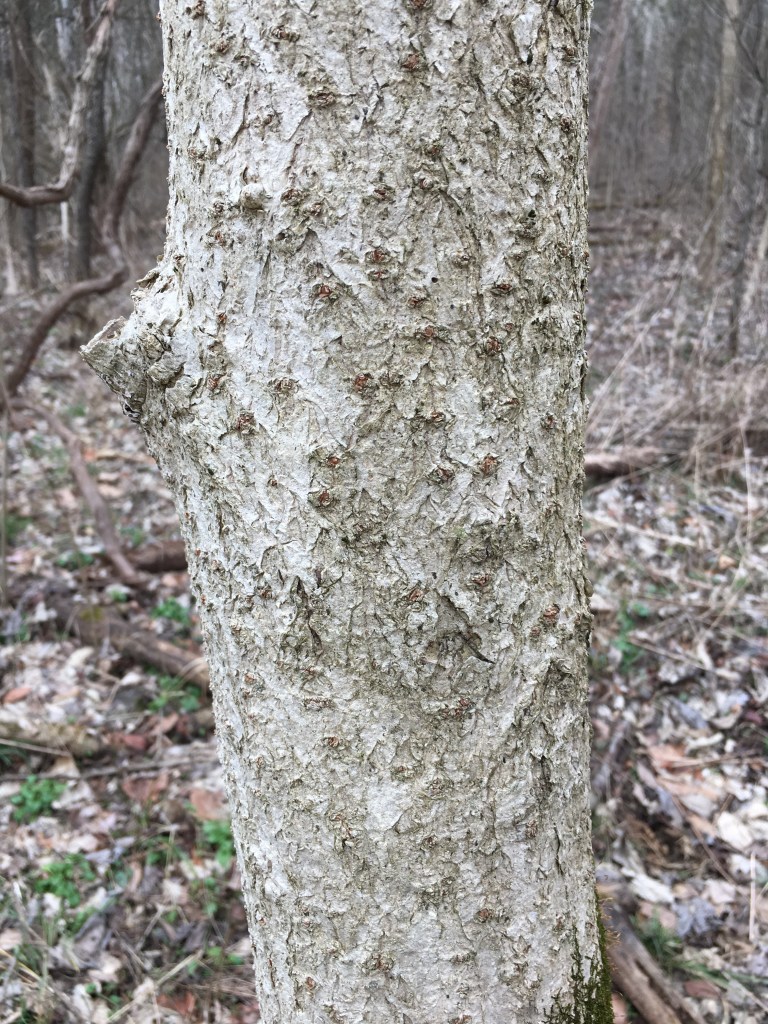
Ohio Buckeyes have ashy white bark and are typically found along streams or in fairly wet soil.
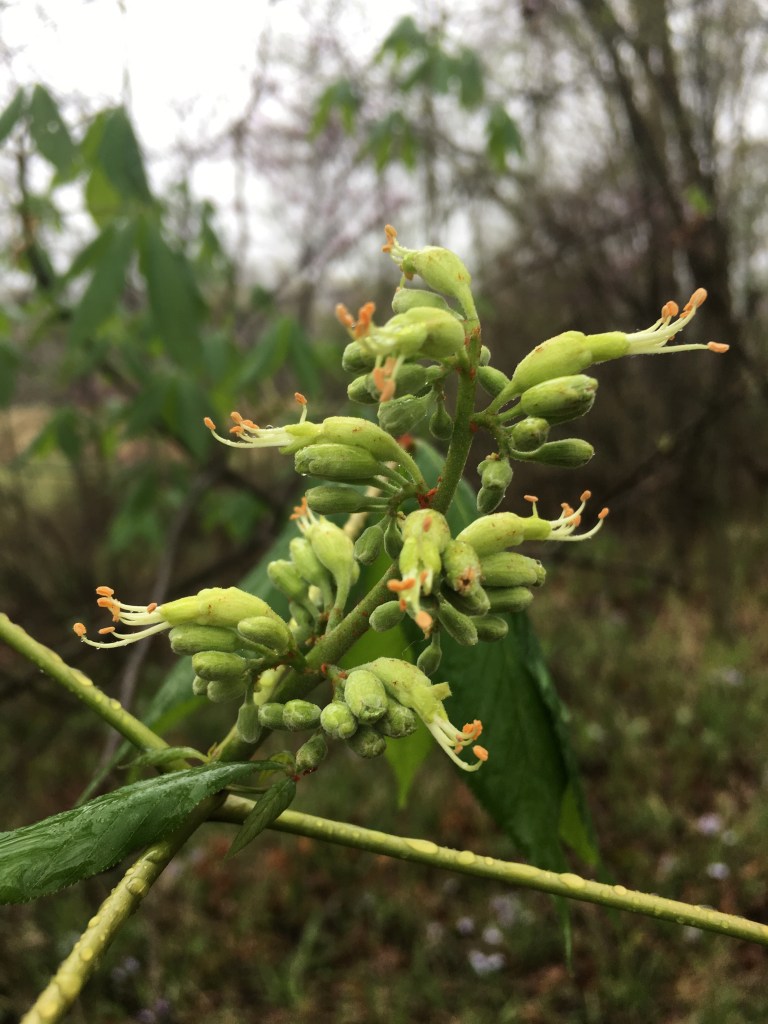
They do have a few close relatives in the area. Most similar is the Yellow Buckeye, which has spineless seed capsules, in Indiana is only found in a couple counties along the Ohio River, and has slightly different flowers. Buckeye flowers appear in large showy clusters. In the Ohio Buckeye, the stamens stick out beyond the petals (as below), where as the Yellow Buckeye’s do not.
Close relatives you might find grown ornamentally are the Horse Chestnut (native to the Balkans, and one of the most common street trees in Europe) and the Red Buckeye. The Red Buckeye has beautiful pink/red flowers. It is native to this region, but it is more of a shrub than a full-scale tree like the Yellow and Ohio Buckeyes.
One other thing about the Ohio Buckeye. It is said to stink. It is called the “fetid buckeye” to distinguish it from the “sweet buckeye” aka the Yellow Buckeye. In my experience it doesn’t actually smell all that bad, at least compared to other stinking trees such as Tree of Heaven. But this could be something that varies seasonally or regionally (or based on the olfactory sensitivity of the smeller).
 recycled paper clips