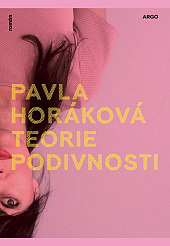
I have at last finished Pavla Horáková’s Teorie Podivnosti, a book chosen more or less at random from the pool of “highly-acclaimed contemporary popular Czech fiction” as a kind of experimental sampling. What is Czech literature currently like? How is it different from American popular literature, and what kind of world-outlook does it evince?
To start with, let me give you a brief summary of the plot. Our protagonist is a woman in her 30s with two PhDs who works at the “Interdisciplinary Institute for the Study of Man,” which she describes as a bureaucratic and soul-sucking institution where all sorts of overly educated drones study a variety of extremely niche hypotheses. Already, one trait of the novel, its “cynicism” is apparent. Ada, the protagonist, sees herself as a rebel, disillusioned with the system. She is friends with a few of her similarly disillusioned coworkers, including one, Valerie, whose son has been missing for many years. The search for this son, who is the ultimate rebel and who has disappeared because he can’t be controlled by the limits of society, forms the basic through-line of this otherwise very meandering book. In the end, this Byronic son who the narrator has been fantasizing about throughout the book, turns up briefly, gets the main character pregnant to provide some kind of an ending, and disappears again. Most of the book is taken up with very frank description of the protagonist’s everyday life.
She has many little pseudo-scientific pet theories, for example, that hirsuteness is a predictor of homelessness. She takes phrenology for an actual science, and makes “observations” such as “The children of cleaners and cooks were exact copies of their mothers. Smart children, however, don’t particularly resemble their parents, they have their own restructured physiognomy”(58). There are other parts of the book which are fairly offensive, for example, there is a custodian without arms whose name is simply “Bezruče,” literally “Armless.” Much could also be said about the patriarchal attitudes internalized by the narrator, for example, that women ought to have long hair and know how to use make-up.
Over the course of the book, the narrator abandons the specialization/technocracy of science, and seeks meaning instead in her own home-spun popular-science version of quantum physics mixed with mysticism (fractals explain everything, somehow). Her “Theory of Strangenesses” takes authority away from the specialist, and gives it back to the individual, who is essentially allowed to create their own truth.
What Teorie Podivnosti amounts to, I propose, is the story of the protagonist’s journey to a distinctively European brand of neoliberalism. As the back of the book says, “And while the society around her clings to emptier and emptier rules, Ada abandons these structures one after the other, and sets out for freedom.” Her valorization of her rebel-lover (who in the Czech context is inevitably tinged with the cool of the anti-communist dissidents) and her disillusionment with the scientific institution for which she works, essentially amount to an espousal of neoliberalism’s negative definition of freedom (freedom = not being told what to do) as a lifestyle. What makes Horáková’s neoliberalism European is that it arises not from an American belief in people’s ability to create themselves, but from a deterministic fatalism that people are where their innate abilities mean they deserve to be. Or at least that’s my working hypothesis.
I don’t think I have enough information to really work this thesis out. But I do think there is a connection between the narrator’s distrust of social consensus, her cynical outlook on social justice, the pride she takes her “individuality,” and the neoliberal elevation of “freedom”— defined as the freedom to be selfish— to the ultimate good.
 recycled paper clips