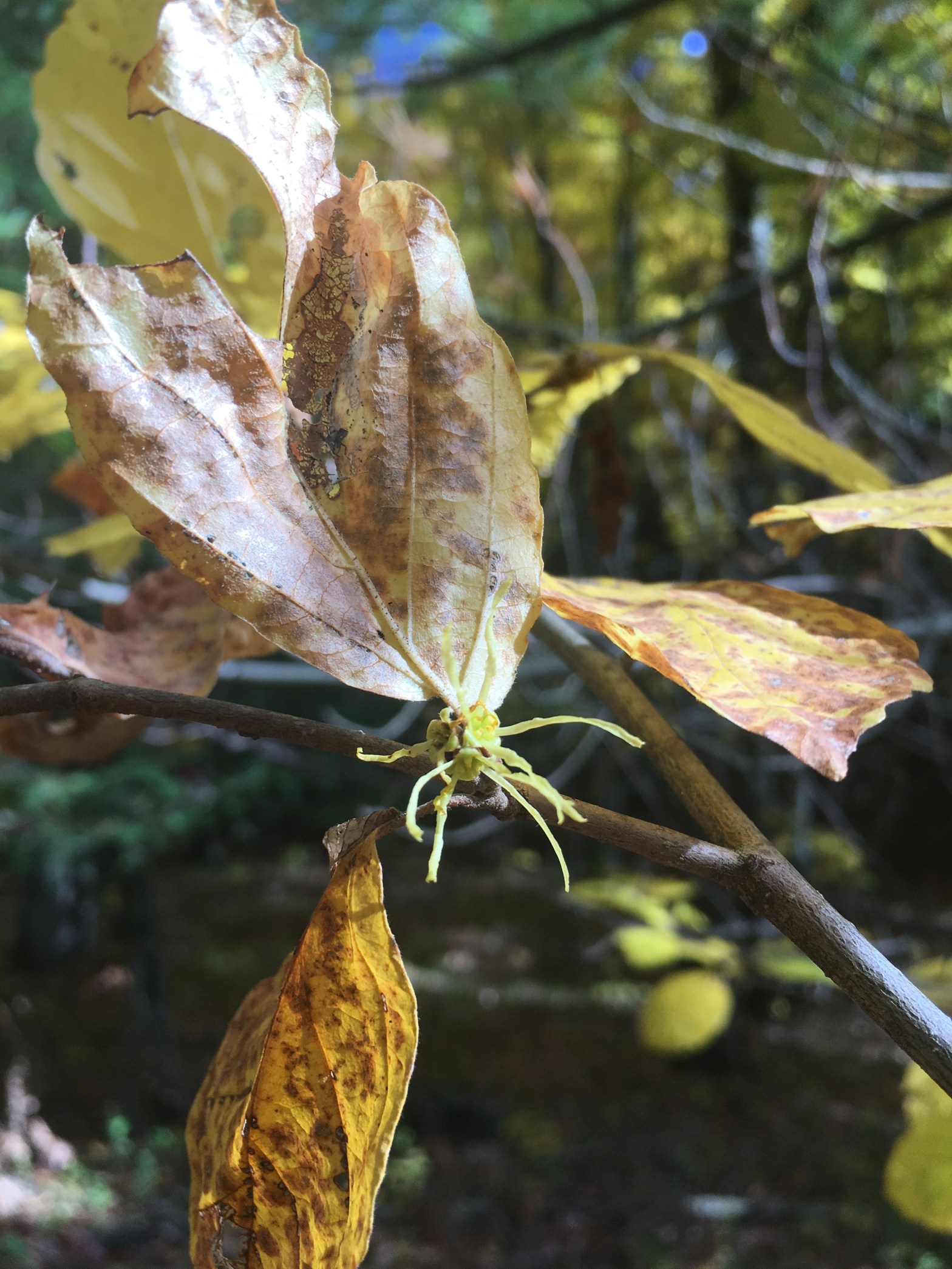
Witch-hazel is fall/winter bloomer, just like the orchids I covered a while back. Perhaps this is part of what makes it “witchy.” In fact, though folk etymologies attribute the name to its use in divining or dowsing, the Online Etymology Dictionary notes that the “witch” in Witch-hazel probably doesn’t come from the common use of the word, but goes back to the Old English wice, meaning “pliant” or bendable.
witch hazel (n.)
1540s, probably from Old English wice “Applied generally or vaguely to various trees having pliant branches” [OED], from wican “to bend” (from PIE root *weik- (2) “to bend, to wind”) + hæsel, used for any bush of the pine family (see hazel (n.)). The North American bush, from which a soothing lotion is made, was so called from 1670s. This is the source of the verb witch in dowsing.
https://www.etymonline.com/word/witch%20hazel
Nonetheless, it is a witchy plant with a spooky flower.
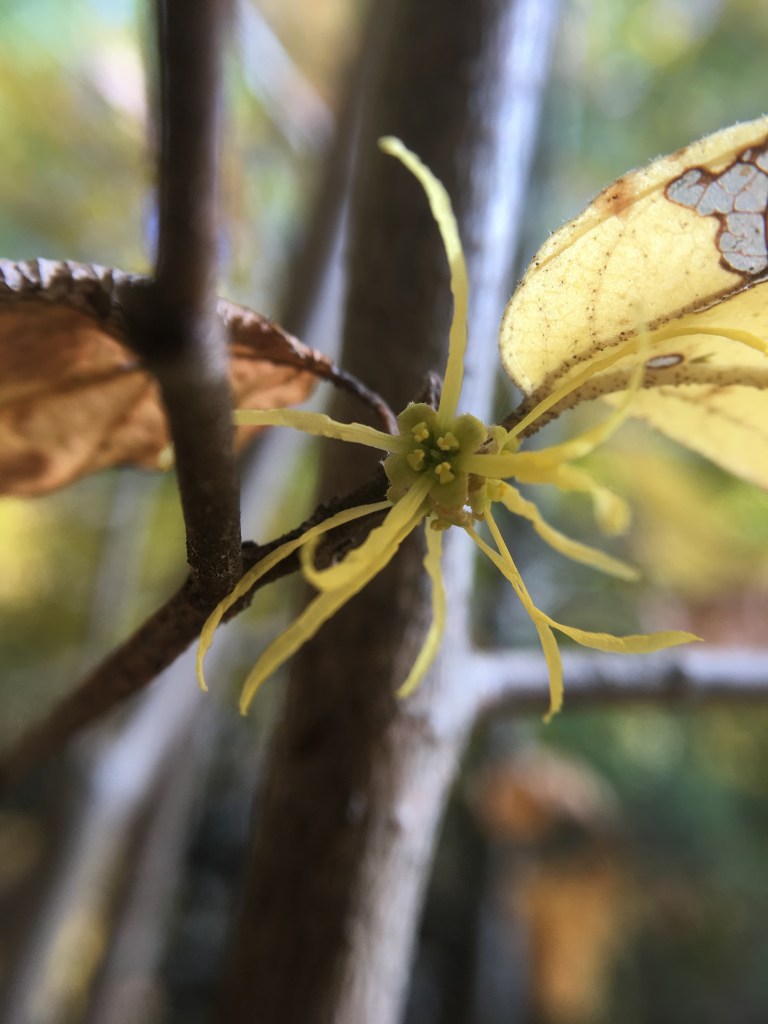
As mentioned above, Witch-hazel has been used extensively for divining or dowsing, which is an occult technique for locating underground water. Some of you may be familiar with Seamus Heaney’s poem “The Diviner.” But the hazel mentioned in that poem is not Witch-hazel, which is native to North America. As the etymological dictionary points out, “hazel” or haesel was used fairly indiscriminately to refer to a variety of shrubs.
If you are curious what dowsing actually involves, I would say it’s rather anti-climactic. It involves holding a forked branch in your hands and walking around until you feel the branch start to point downwards (or until you unconsciously let it slide). At the spot it points to you will find water, or metal ore, or whatever it is you are witching for. According to wikipedia, during the Vietnam war, “some US Marines used dowsing to attempt to locate weapons and tunnels.”
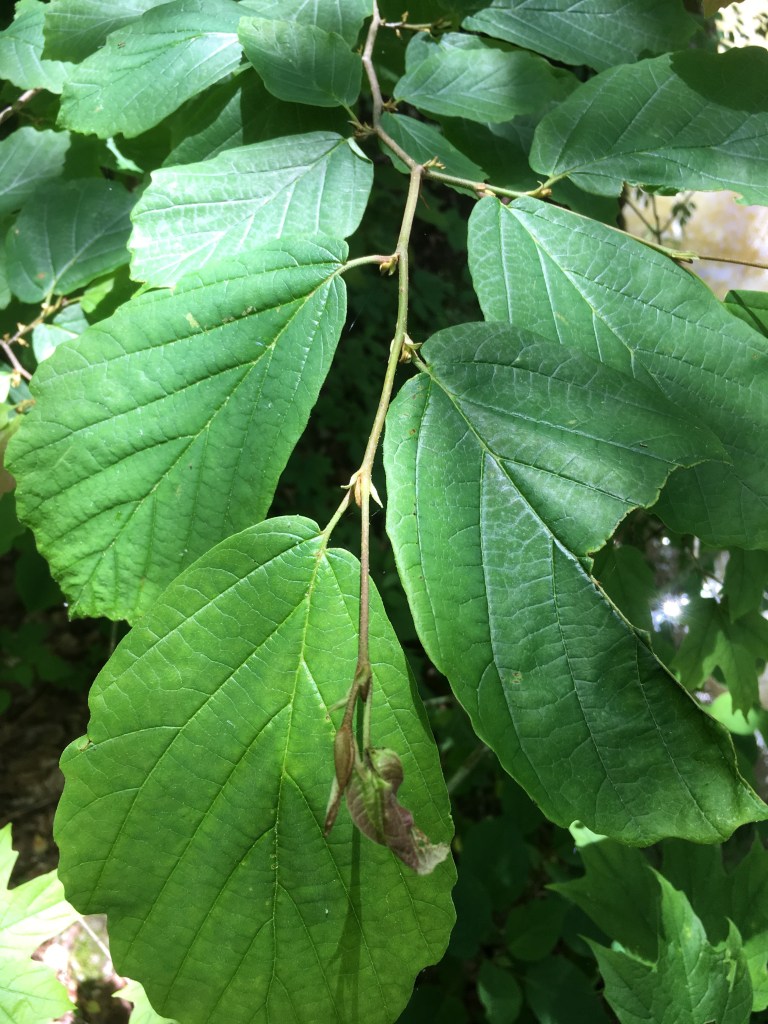
Identifying the plant is easy in the fall because of the presence of the flowers. In the Spring or Summer it can be identified by its broadly rounded teeth, frequently uneven leaf base, and its preference for moist woods and streams.
A final fun fact about Witch-hazel is that it forcefully expels its seeds, in fact with enough force to propel them up to 30ft. I haven’t been able to find a video of this, or see it in action, but I would recommend this video from the Smithsonian about other plants, like violets and touch-me-nots, that disperse their seeds via “explosion.”
 recycled paper clips