
It’s interesting how much of an impact street names have on our knowledge of trees. Pretty much everyone knows that Oaks, Hickories, Walnuts, and Elms are trees, even if most people can’t identify them. I am reminded of the chapter called “Place-Names” in Proust, how some words exist that no longer refer to anything particular, but are left after generations of use like phantom words, strangely resonant because hollow. But no streets have been named after Ailanthus altissima, the “Tree of Heaven,” so up until recently I had no idea what it was.

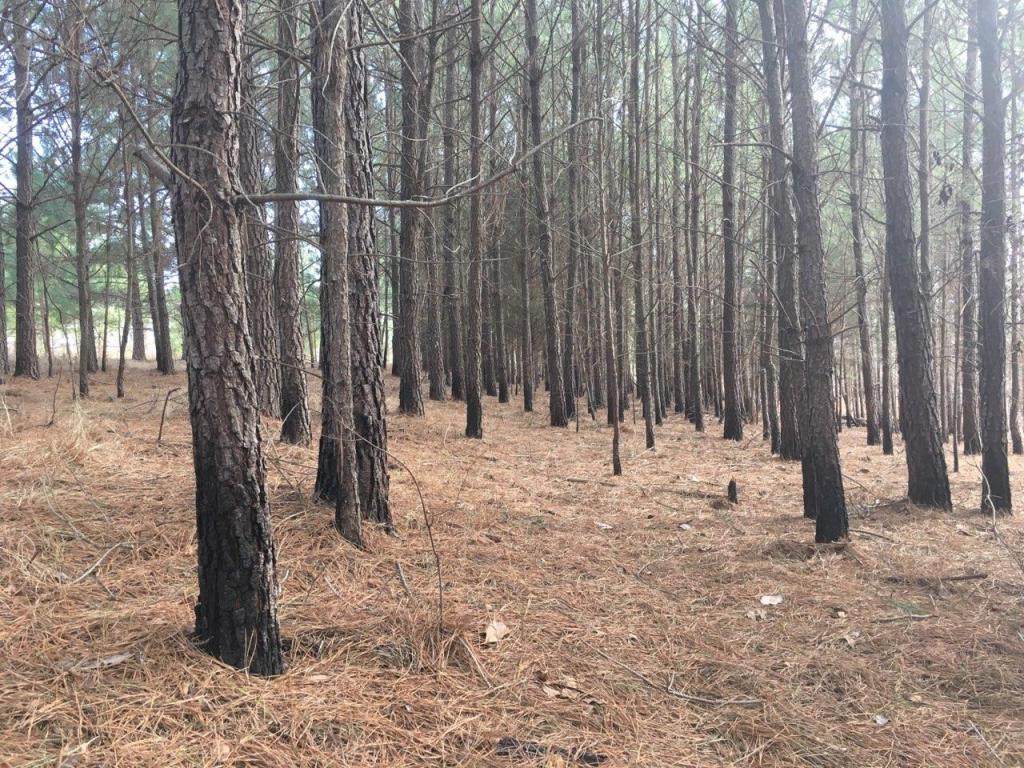
Turns out, it’s pretty much everywhere, and is one of the most universally hated tree species out there, despite its heavenly name. As far as I can make out, the name comes from the fact that it grows especially fast (10 feet in one year), as if it were striving to reach heaven, or merely the sky. It’s hated because it’s hard to eradicate, spreads rapidly through suckers, and like another much hated invasive plant I’ve written about, Garlic Mustard, is a master of allelopathy (one of the most musical ecological terms I know of). Allelopathy is the chemical inhibition of other plants. For example, pine trees are allelopathic because their needles keep other plants from growing around them— which is why there is so little underbrush in pine stands.
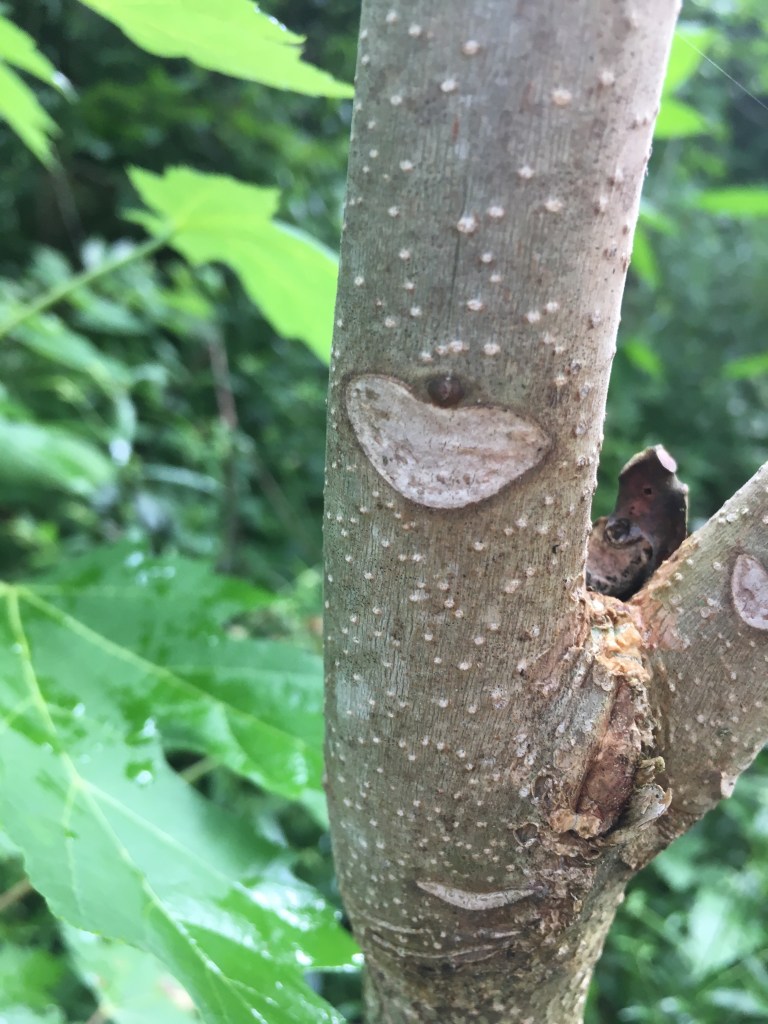
Tree of Heaven looks a lot like Black Walnut from a distance. Giant pinnately compound leaves which leaf out at about the same time of year. Bark is a major give-away though: Walnuts have furrowed dark chocolatey bark, that of Tree of Heaven is flat and grey and features large leaf scars (on branches and smaller trees).
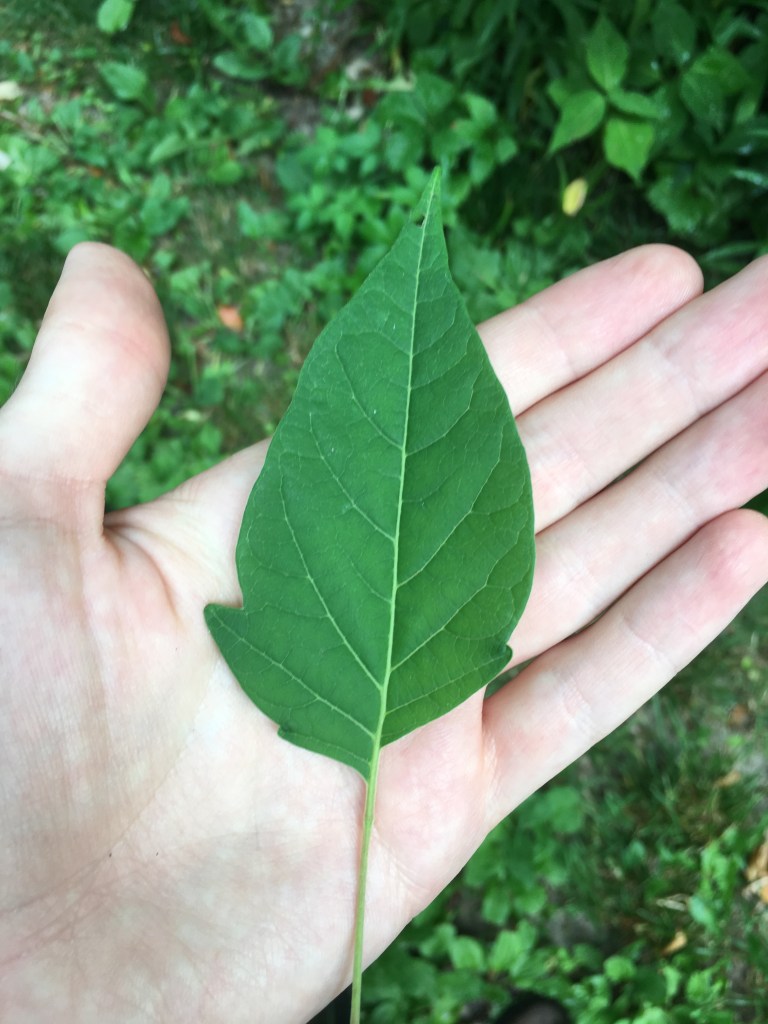
Another interesting difference on closer inspection is the leaflets. Tree of Heaven has a very distinctive glandular tooth towards the base of the leaf. These glands (I think) are responsible for the foul smell of the crushed leaves—to me something like almond, but mealy and rotten. These glands and the odor help to distinguish Tree of Heaven from Sumacs, which also have big compound leaves. (There is at least one American street named after the Sumac —in Philadelphia–by the way…)
Despite all its negative qualities I think Tree of Heaven is worth knowing, even seeking out at least once, because I’m always drawn to trees that are distinctive in non-visual ways. Unpleasant as the smell is, I think it’s important to experience your environment more than just visually. Slippery Elm, possibly my all time favorite tree, is the king of texture. The roughness of the leaves and the gooeyness of the inner bark–not to mention the styrofoam corkiness of the young trunk. Tree of Heaven is, if not the king, at least the knave, of olfaction.
 recycled paper clips
One thought on “Tree of Heaven: Tree Identification with your Nose”