Ok, you’ve spotted it, growing there a couple yards off the path:
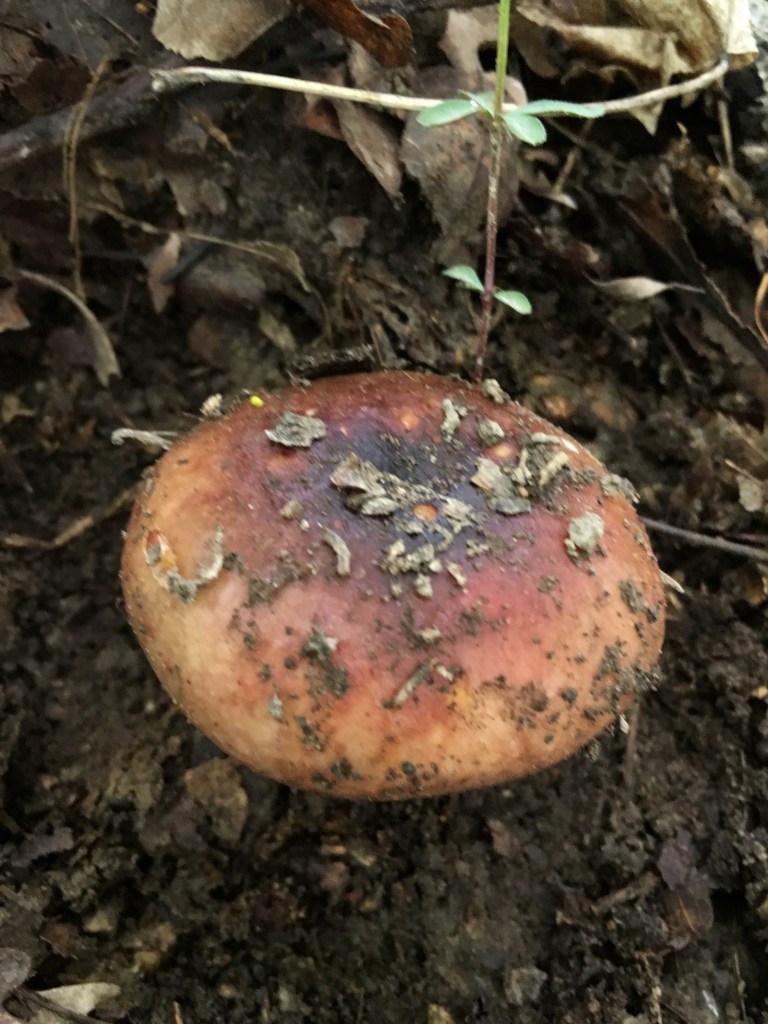
now what? Well, first look up and see what’s growing around it. In this case, we’ve got a pretty mixed hardwood forest, oaks, hickories and tulips. Is it growing on wood? No, it’s terrestrial, this means we probably have a mycorrhizal mushroom (meaning it forms a symbiotic association with the root system of a tree). Next, we carefully dig it out of the ground, trying to preserve the entire stem.
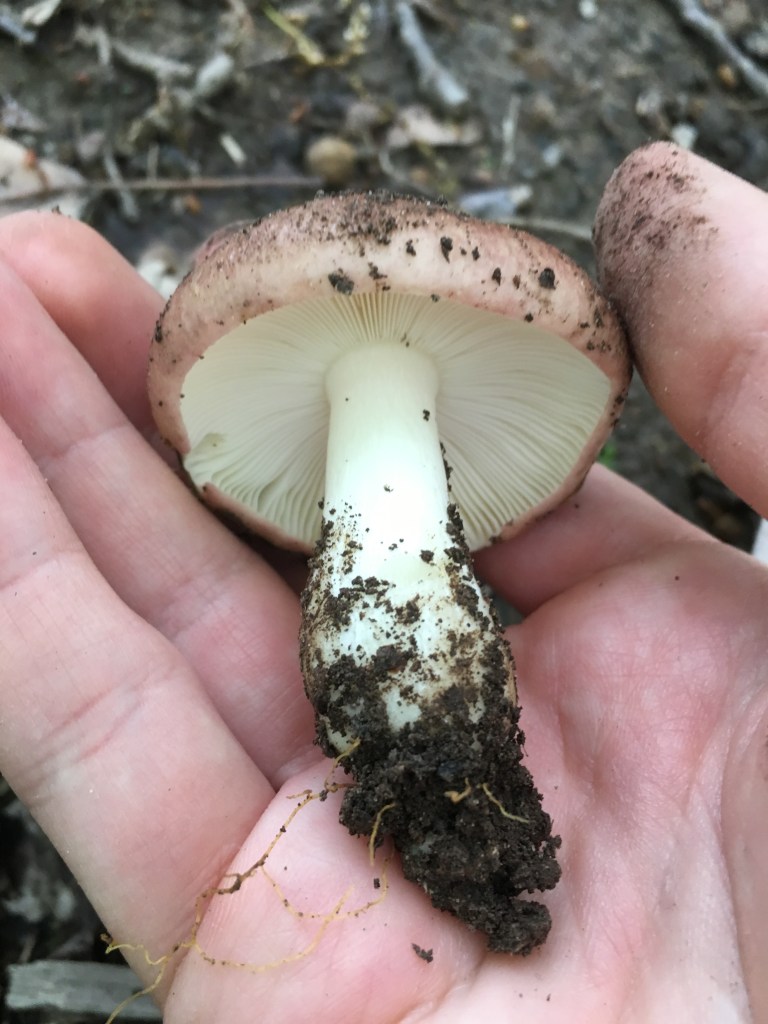
And now it’s time to get out the guide book and look for the identification key. Let’s go!
Question #1— gills? Yes. #2—Growing shelf-like on wood? No. #3—False gills? (ie. not separable from the mushroom) No, we’ve got true, “plate-like” gills. #4—Spore print pink to brownish pink?…
Now we’ve got to go home and take a spore print. Basically, you place the cap flat on a sheet of aluminum foil, cover it with a glass jar so no air gets in or out, and wait overnight.
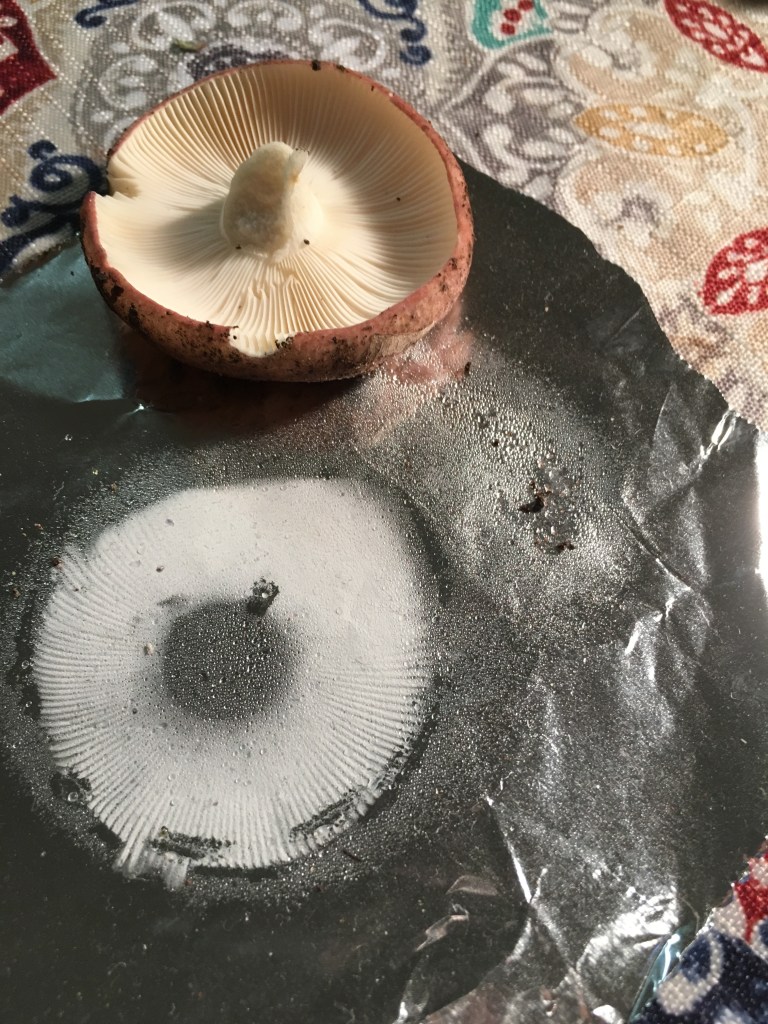
Our spore print is definitely not pink, so moving on. #5— Spore print white, yellow to orange, lilac, or green? Yes, it’s white. #6—Spore print green? Nope. #7—Mushroom with a universal veil, a slime veil, and/or a partial veil?
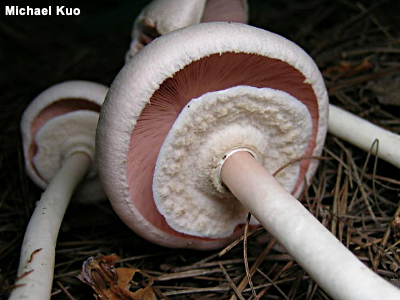

Nope, none of those. Our mushroom has a clean, simple stipe. #8— Gills very thick, waxy, distantly spaced? No, they are thin and closely spaced. #9—Mushroom producing a white, colorless, or colored “milk” when injured?
Usually in order to identify a mushroom you have to mangle it a bit. Get out a knife a slice the gills slightly and then cut the mushroom in half.
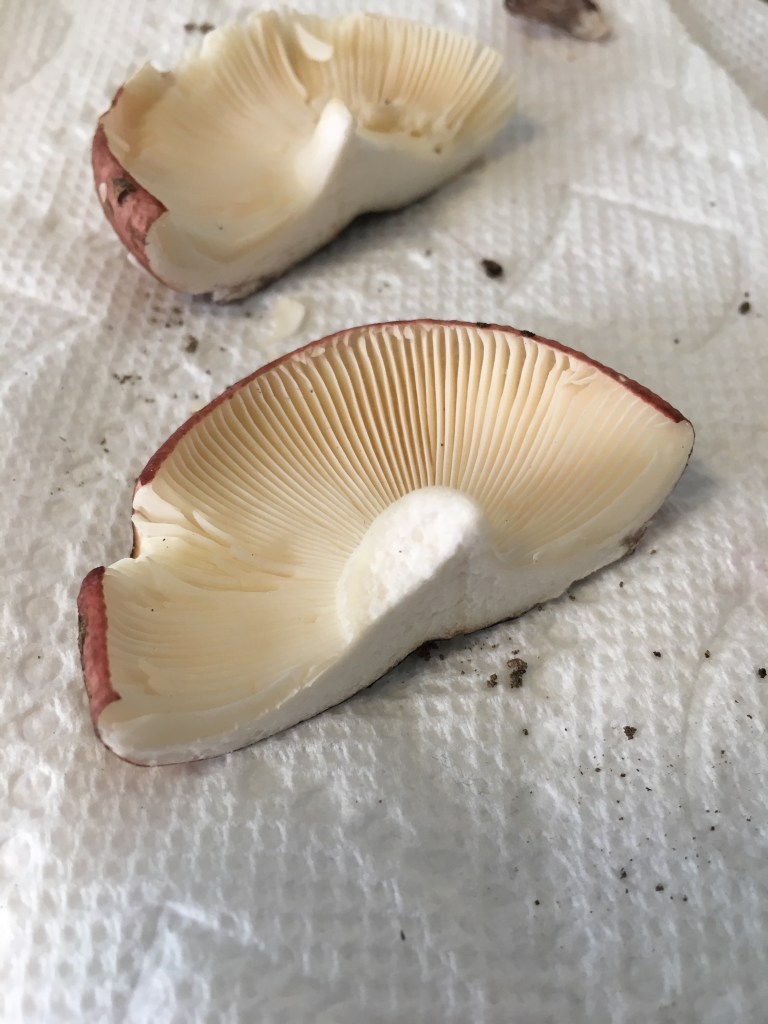
Nope, no “milk.” #10—Flesh white, crumbly, and brittle; stem usually brittle; cap about as wide as the stem is long? Yes, as a matter of fact. The stem has the feel of very soft chalk. Notice also that the stem is solid all the way through and their are no “fibers” running up and down it. This means we’ve narrowed it down to about 750 species in the genus Russula. Congrats!
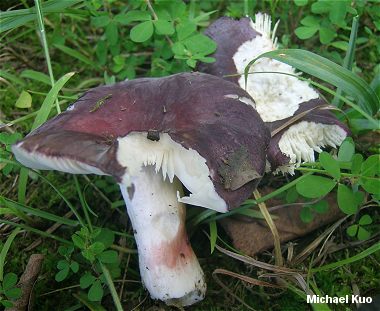
#11 — distinctive strong odor? Nope. #12—surfaces bruising red, then black? Gently bruise the cap of the mushroom with a fingernail. Nope, no bruise. #13— Gills white, soft, and frequently forked; cap usually mottled purple and green. No, our gills are quite regular and there’s not a hint of green. #14—Cap purple to purplish red; when young with a whitish dusting; stem flushed with purple or pink. Hmm, this is a tough call, but I’m not seeing any purple or pink on the stem, so no. (if yes, then we would have had Russula mariae:
#15— Young cap with a layer of yellow, powdery granules? No. #16—Gills and stem bruising slowing but conspicuously reddish brown; cap near white when young? No. #17—Cap some shade of yellow or brown? Again, a tough call, but I’m going to say our cap color is closer to red or pink than brown. #18—Associated with conifers? (Remember how we check the trees around it?) Definitely not. #19—Flesh extremely fragile and brittle (cap and stem very soon falling apart)? Well, I got it home in one piece so probably not. #20—Mature cap thin, usually <5cm across; stem flushed with pink. Our cap is almost exactly 5cm but it seems to be a younger specimen so it could continue to grow, the stem isn’t flushed with pink, and the cap is equal in width to the height of the stipe, so I wouldn’t call it “thin.” So no. #21—Appearing in spring; taste mild; stem discoloring gray with age. Hmm, that could be it. Let’s read more:
In the Midwest this species is common, distinct, and fairly easily identified (that is, for a red Russula). It appears in oak forests in late spring or very early summer, usually just after morel season, often competing with Cortinarius distans to be the first mycorrhizal gilled mushroom of the year. Its cap ranges from blood red to nearly purple, with a very dark (sometimes nearly black) center; the “skin” peels easily away from the margin, about halfway to the center. The stem, in old age, begins to turn gray. The taste is mild or slightly acrid, and the spore print is white.
https://www.mushroomexpert.com/russula_vinacea.html
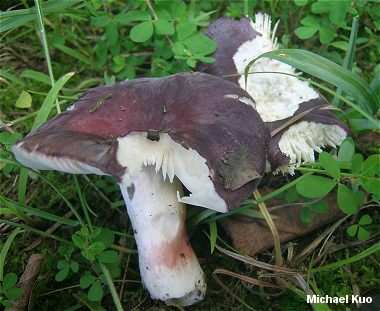
We are at the tail end of morel season, so the timing is right. The taste is (remember to spit it out!) I would say slightly acrid, maybe faintly peppery. It is black in the center, and lastly, the skin does peel somewhat easily from the margin:
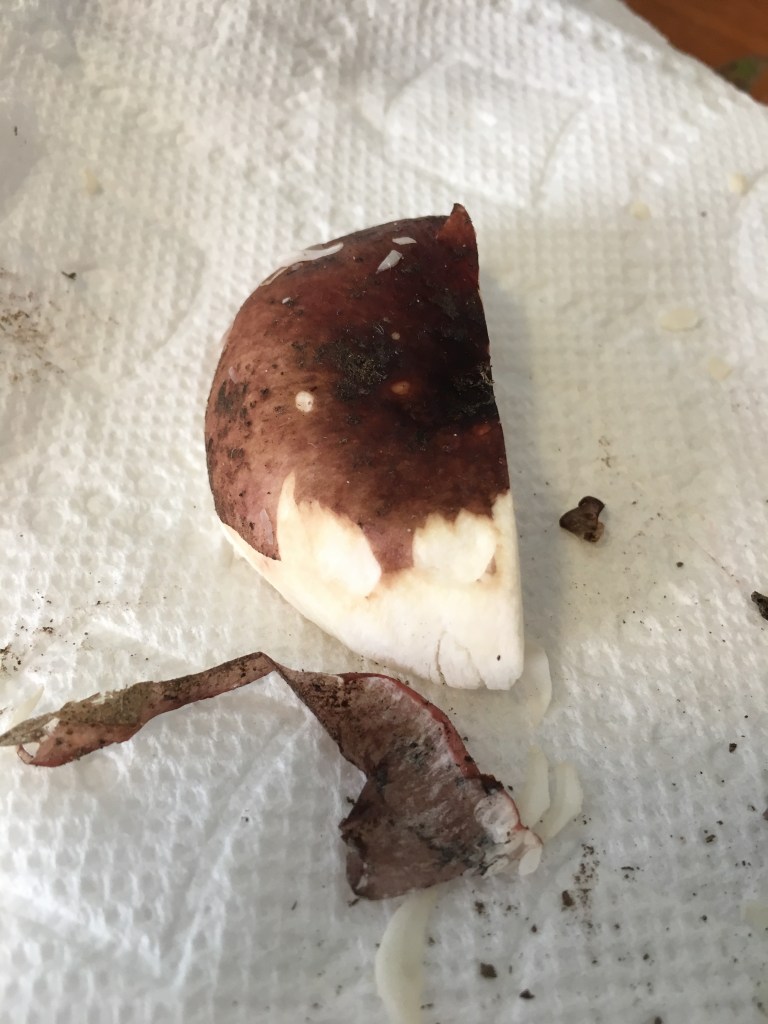
So I think we have a winner: Russula vinacea. Or as I propose to baptize it: “The Spring Russet Potato Mushroom.” We’ve done it, thanks for playing Mushroom 21 questions with me!
 recycled paper clips
One thought on “How to ID a Mushroom”