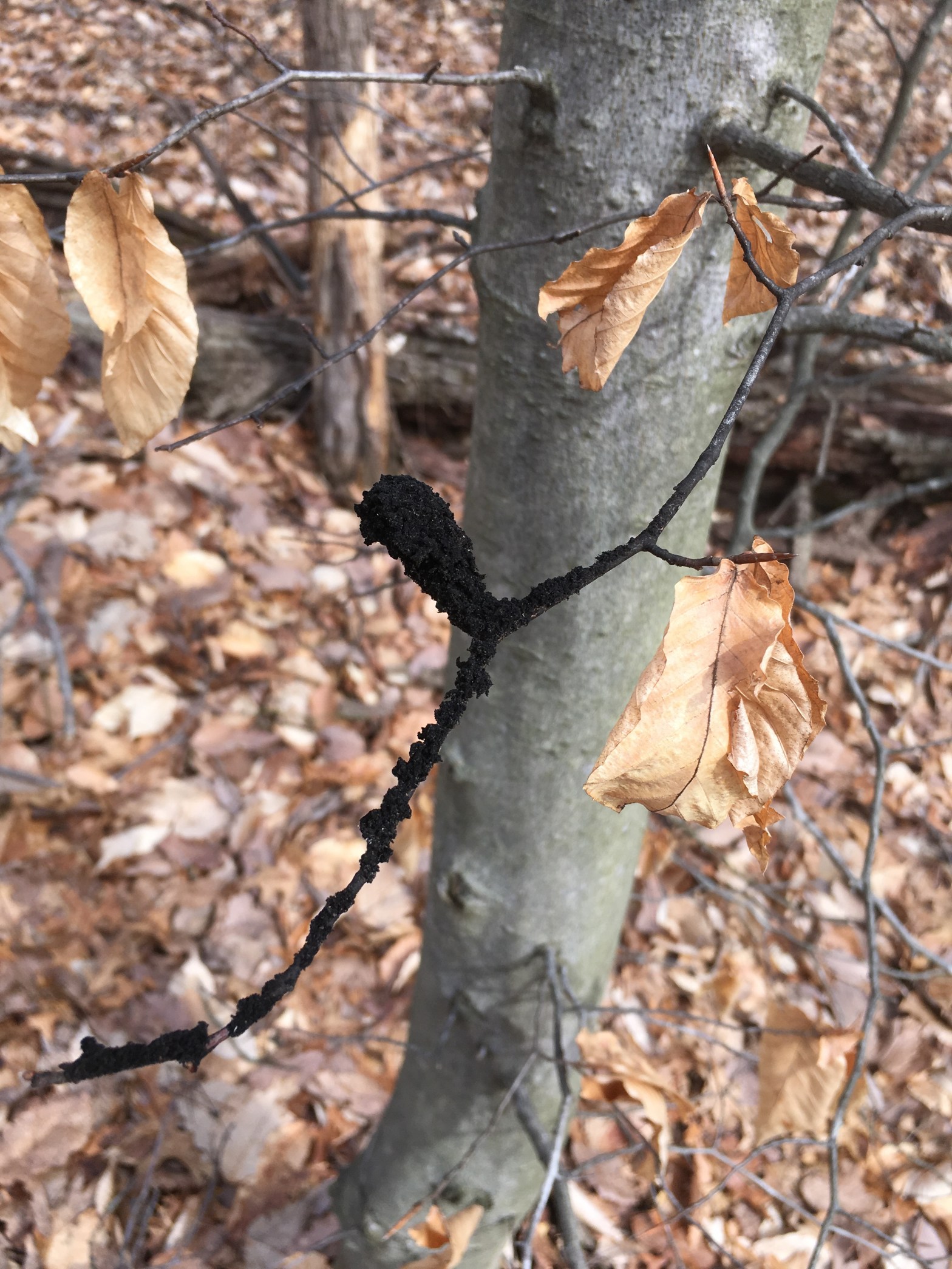
This time of year beech trees really stick out because for whatever reason, though their leaves die and turn a beautiful translucent brown, many of them remain on the tree, creating a sort of ghostly afterimage of the full grown summer plant. Like this:

When I took a closer look at some beech trees on a hike yesterday I noticed the above charred-marshmallow-like formation and it reminded my of some “earth tongue” mushrooms, like the one below:
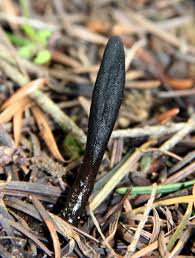
Curious if there was any relationship, I decided to do some research. It turns out that the above beech mould is “scorias spongiosa,” which grows on aphid honeydew. To quote wikipedia, “Scorias spongiosa is a specialist and grows exclusively on the honeydew formed by colonies of the beech blight aphid, Grylloprociphilus imbricator. This aphid is found only on one host plant, the American beech tree, Fagus grandifolia, where it congregates on branches and twigs, creating copious amounts of honeydew that drip onto vegetation below.[1] The large quantity of honeydew enables this fungus to grow to a large size, much bigger than other sooty mould fungi, which produce only a thin black layer on the surface of leaves. On tree trunks this fungus has been known to grow into a mass of hyphae as big as a football, but it is more usual for the agglomeration on branches or twigs to reach a diameter of about fifteen centimetres.”
Scorias spongiosa and black earth tongues are in the same phylum, but are not particularly closely related. So there you have it, and by the way, scorias spongiosa (or should we just call it the sooty beech tree mold?) is not itself harmful to the tree, but does betray the presence of the beech blight aphid.
 recycled paper clips
One thought on “What’s up with this beech tree?”